
The propagation delay of the $2 \times 1$ MUX shown in the circuit is 10 ns. Consider the propagation delay of the inverter as 0 ns. 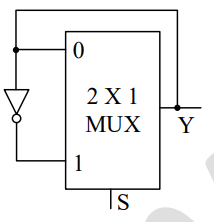
If S is set to 1 then the output Y is ____________.
To determine the behavior of the output \( Y \) when the select line \( S \) is set to \( 1 \), we must analyze the feedback path of the circuit.
1. Circuit Logic Analysis
- The circuit uses a \( 2 \times 1 \) Multiplexer (MUX). The output equation of a \( 2 \times 1 \) MUX is: \( Y = \overline{S} \cdot I_0 + S \cdot I_1 \)
- When \( S = 1 \), the MUX selects input \( I_1 \).
- Input \( I_1 \) is connected to the output \( Y \) via an inverter (NOT gate).
- Therefore, the logical operation of the circuit becomes: $$Y_{next} = \overline{Y_{current}}$$
This configuration, where the output is fed back to the input with an odd number of inversions, forms a ring oscillator. The output will continuously toggle between '0' and '1', creating a square wave.
2. Determining the Time Period (\( T \))
The time taken for the output to complete one full cycle (going from \( 0 \rightarrow 1 \rightarrow 0 \)) is twice the total propagation delay of the feedback loop.
- Propagation delay of MUX (\( t_{MUX} \)) = \( 10 \text{ ns} \)
- Propagation delay of Inverter (\( t_{Inv} \)) = \( 0 \text{ ns} \)
- Total delay for a single transition (\( \Delta t \)) = \( t_{MUX} + t_{Inv} = 10 \text{ ns} + 0 \text{ ns} = 10 \text{ ns} \)
A full cycle consists of two transitions (low-to-high and high-to-low):
$$T = 2 \times \Delta t = 2 \times 10 \text{ ns} = 20 \text{ ns}$$
3. Calculating the Frequency (\( f \))
The frequency is the reciprocal of the time period:
$$f = \frac{1}{T}$$ $$f = \frac{1}{20 \times 10^{-9} \text{ s}}$$ $$f = \frac{10^9}{20} \text{ Hz} = 50 \times 10^6 \text{ Hz}$$ $$f = 50 \text{ MHz}$$
Final Conclusion
Since the output toggles with a calculated frequency of \( 50 \text{ MHz} \), the correct choice is:
A square wave of frequency 50 MHz
Important Questions from Multiplexer
The number of control lines in a multiplexer is 5, identify the MUX.
Number of control lines required for 16 to 1 multiplexer is _____
In a multiplexer, the number of input lines is ‘n’ and the number of select lines is ‘m’. Which of the following is correct?
________ is used to carry digital data on analog lines.
Consider the sentence below.
There is a country that borders both India and Pakistan.
Which of the following logical expressions express the above sentence correctly when the predicate Country(x) represents that x is a country and Borders(x, y) represents that the countries x and y share the border?


