
The process in an operating system in which the output of any program is not printed directly on printer but dumped onto a reserved area of a disk is known as ______.
Spooling
Understanding Operating System Output Management
Operating systems manage various resources, including input/output (I/O) devices like printers. Printers are typically much slower than the CPU and the processes generating output. If a program had to wait for the printer to finish before continuing, the system's efficiency would be significantly reduced, especially if multiple programs want to print simultaneously.
What is the Process of Buffering Output on Disk?
The question describes a process where the output of a program is not sent directly to a slow device like a printer. Instead, this output is temporarily stored in a dedicated area on a faster storage medium, like a disk. From this disk area, the operating system can then send the data to the printer at the printer's own speed, without holding up the program that generated the output.
Identifying the Correct Operating System Technique
Let's look at the options provided:
- Swapping: This is a memory management technique used by the operating system to move processes or parts of processes from RAM (main memory) to secondary storage (disk) and vice versa. Its purpose is to allow more processes to run than can fit entirely in RAM. It is not related to buffering output for I/O devices.
- Teardown operation: This term typically refers to the process of releasing resources and cleaning up after a task, program, or connection has finished execution. It doesn't describe the buffering of output.
- Spooling: This stands for Simultaneous Peripheral Operations Online. Spooling is a technique where data that is intended for a peripheral device (like a printer or card reader) is first put into a buffer on a disk. This buffer is called a spool file or spool area. The operating system then manages the transfer of data from the spool area to the device at the device's speed. This technique allows programs to finish their output operations quickly by writing to disk, and the slow device can process the data independently later. This exactly matches the description in the question.
- System call: A system call is a request made by a program to the operating system's kernel to perform an action on its behalf (e.g., file operations, process creation, I/O operations). While initiating a print job might involve a system call, the system call itself is the request, not the buffering process on disk.
Based on the definitions, the process of dumping output onto a reserved area of a disk instead of printing directly is known as Spooling.
Benefits of Using Spooling for Printer Output
- Improved System Throughput: Programs don't have to wait for the slow printer, allowing them to release CPU resources and finish faster.
- Resource Sharing: Multiple programs can send output to the printer simultaneously; the spooling system manages a queue of print jobs.
- Device Independence: The program writes to the spool file in a standard format, and the spooling system handles the specifics of the printer.
| Concept | Primary Purpose | Involves Disk Use For | Relation to Question |
|---|---|---|---|
| Spooling | Buffer data for slow I/O devices (like printers) | Temporarily storing device data (e.g., print jobs) | Directly matches the process described |
| Swapping | Memory management | Storing entire processes or pages temporarily from RAM | Not related to I/O output buffering |
| System Call | Program requests OS service | Could be used to initiate a spooled print job, but isn't the spooling process itself | A mechanism, not the buffering process |
Revision Table: Operating System Concepts
| Term | Explanation | Context |
|---|---|---|
| Spooling | Buffering data for slow I/O devices on disk. | Managing print jobs, card reader input, etc. |
| Swapping | Moving processes between RAM and disk to manage memory. | Virtual memory management. |
| System Call | A program requesting a service from the OS kernel. | Accessing hardware, creating processes, file operations. |
| Teardown Operation | Cleaning up resources after a process/task finishes. | Process termination, connection closing. |
Additional Information on Spooling and Buffering
Spooling is a specific type of buffering. Buffering, in general, involves using a temporary storage area to hold data while it's being transferred between devices or processes. Spooling is buffering data specifically for I/O devices, typically using a disk as the buffer medium, and is managed by a dedicated part of the operating system or a service (often called a spooler or daemon). This allows the CPU to work on other tasks while the I/O operation proceeds in the background.
Another common example of spooling is handling input from slow devices, although printer output spooling is perhaps the most well-known application today.
Important Questions from Miscellaneous
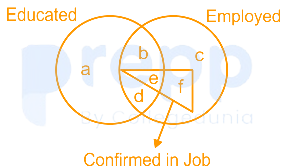
Read the given figure and find the region representing persons who are educated and employed but not confirmed in job.
The magazine in which Mahatma Gandhi mentioned what he wanted the Constitution to do is:
Which gas shields the surface of the earth from ultraviolet radiation from the sun?
Which event is marked as an Intangible Cultural Heritage of Humanity by UNESCO?
Who has been conferred with the rank of the Commander of the Order of the British Empire in 2018?


