
The plant in the feedback control system shown in the figure is $P(s) = \frac{a}{s^2-b^2}$, where $a>0$ and $b>0$. The type(s) of controller $C(s)$ that CANNOT stabilize the plant is/are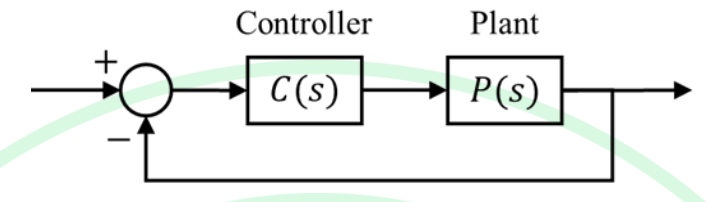
The given plant in the feedback control system is represented by the transfer function \(P(s) = \frac{a}{s^2 - b^2}\), where \(a > 0\) and \(b > 0\). Our goal is to determine which types of controllers, \(C(s)\), cannot stabilize this plant.
To analyze the stability, we need to consider the characteristic equation of the closed-loop system, which is derived from the feedback loop:
\(1 + C(s)P(s) = 0\)
Substituting the given plant, we have:
\(1 + C(s)\frac{a}{s^2 - b^2} = 0 \Rightarrow s^2 - b^2 + aC(s) = 0\)
To stabilize the system, we need a controller \(C(s)\) that effectively alters the poles of the characteristic equation so that they lie on the left half of the complex plane.
- Proportional (P) Controller:
- For \(C(s) = K_p\), the characteristic equation becomes \(s^2 + aK_p - b^2 = 0\).
- This is a quadratic equation with real coefficients. However, it does not introduce complex poles or shift them to the left half-plane unless \(K_p\) is specifically tuned, which is often impractical purely by proportional control.
- Therefore, a P controller alone cannot ensure stabilization.
- Integral (I) Controller:
- For \(C(s) = \frac{K_i}{s}\), the characteristic equation becomes \(s^3 - b^2s + aK_i = 0\).
- This introduces an additional pole at the origin, complicating stability due to increased order without guaranteed effect on stability.
- An I controller alone cannot stabilize the plant, as it tends to introduce more complexity and negative damping.
- Proportional-Integral (PI) Controller:
- For \(C(s) = K_p + \frac{K_i}{s}\), the characteristic equation is \(s^3 + (aK_p)s - b^2s + aK_i = 0\).
- This also increases the system order and can result in instability similar to I controller effects without additional tuning complexity.
- PI control does not inherently solve the stability issues presented by the plant dynamics.
- Proportional-Derivative (PD) Controller:
- With \(C(s) = K_p + K_d s\), the characteristic equation becomes \(s^2 + (aK_d)s + (aK_p - b^2) = 0\).
- This configuration allows for the placement of poles by tuning \(K_p\) and \(K_d\) to ensure root locus in the left half-plane, thereby stabilizing the system.
In conclusion, a PD controller can be used to stabilize this plant by appropriate tuning. However, P, I, and PI controllers cannot stabilize the plant effectively without additional control strategies.
Therefore, the types of controllers that cannot stabilize the plant are the Proportional (P) Controller, Integral (I) Controller, and Proportional-Integral (PI) Controller.
Important Questions from Controllers
What effect does the proportional parameter of control response have on the rise time in a closed-loop control system?
Which control method is best suitable to eliminate steady state error in closed loop response?
Which of the following is considered as a controller in an automatic toaster system ?
In a feedback control system, the derivative (D) controller has an output proportional to:
A condition where integral control drives the output of a controller into saturation is called ______


