The periodic time of one oscillation for a simple pendulum is:
Understanding the Simple Pendulum
A simple pendulum is a fundamental system in physics that demonstrates oscillatory motion. It typically consists of a point mass, often called a bob, suspended from a fixed support by a massless, inextensible string or rod. When the bob is displaced from its equilibrium (vertical) position and released, it swings back and forth under the influence of gravity, tracing a circular arc.
Periodic Time of Oscillation Defined
The periodic time, or time period (\(T\)), of a simple pendulum refers to the duration it takes for the pendulum to complete one full oscillation. A complete oscillation means the pendulum bob starts from a specific point, swings to one extreme, then to the other extreme, and finally returns to its initial starting point. For small angular displacements (typically less than 10-15 degrees), the motion of a simple pendulum closely approximates Simple Harmonic Motion (SHM).
Factors Influencing the Periodic Time
The periodic time of one oscillation for a simple pendulum is primarily determined by two physical quantities:
- Length of the pendulum (\(l\)): This is the effective length, measured from the point of suspension to the center of mass of the pendulum bob.
- Acceleration due to gravity (\(g\)): This is the local acceleration experienced by falling objects, which varies slightly with geographical location.
It's important to note that, for small oscillations, the periodic time of a simple pendulum is essentially independent of the mass of the bob and the amplitude of the oscillation.
Formula for Periodic Time of a Simple Pendulum
The universally accepted formula for the periodic time of one oscillation for a simple pendulum performing small oscillations is given by:
\[T = 2\pi \sqrt {\frac{l}{g}}\]
Where:
- \(T\) represents the periodic time in seconds (s).
- \(\pi\) (pi) is a mathematical constant, approximately 3.14159.
- \(l\) represents the effective length of the pendulum in meters (m).
- \(g\) represents the acceleration due to gravity in meters per second squared (\(m/s^2\)).
Analyzing the Provided Options
Let's carefully examine each given option in comparison to the correct formula for the periodic time of a simple pendulum:
- Option 1: \(2\pi \sqrt {\frac{g}{l}}\). This formula incorrectly places \(g\) in the numerator and \(l\) in the denominator under the square root. The relationship should be \(l\) over \(g\).
- Option 2: \(\frac{1}{{2\pi }}\sqrt {\frac{g}{l}}\). This option not only has \(g\) in the numerator but also incorrectly uses \(\frac{1}{{2\pi }}\) instead of \(2\pi\).
- Option 3: \(2\pi \sqrt {\frac{l}{g}}\). This formula precisely matches the established formula for the periodic time of a simple pendulum, having \(l\) in the numerator and \(g\) in the denominator within the square root, all multiplied by \(2\pi\).
- Option 4: \(\frac{1}{{2\pi }}\sqrt {\frac{l}{g}}\). While this option has the correct ratio of \(l\) over \(g\) inside the square root, it incorrectly uses \(\frac{1}{{2\pi }}\) instead of \(2\pi\).
Based on this analysis, the formula that accurately represents the periodic time of one oscillation for a simple pendulum is \(2\pi \sqrt {\frac{l}{g}}\).
Important Questions from Vibration of Beam and Pendulum
The natural frequency of a simply supported beam of length l with mass M at its centre, flexural rigidity EI and negligible beam mass is
The fundamental natural frequency of the cantilever beam with point load P acting at the free end, in rad/sec is
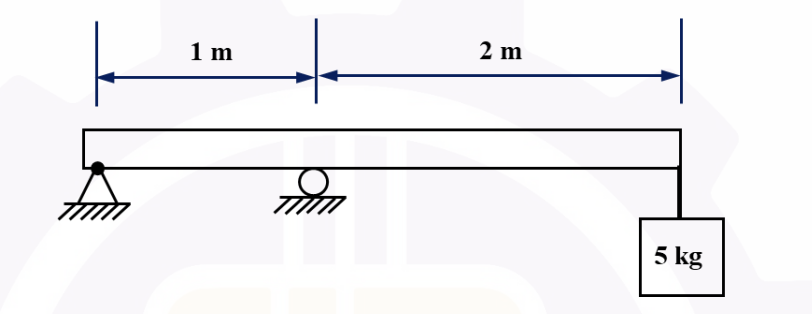
A 5 kg mass is suspended at the free end of an overhanging massless beam, having a pin support and a roller support, as shown in the figure below. Young's modulus of the material of the beam is 200 GPa and area moment of inertia of the beam is $10^{-8}$ m$^4$. The natural frequency of the beam in rad/s is