
The opamps in the circuit shown are ideal, but have saturation voltages of $\pm 10$ V. 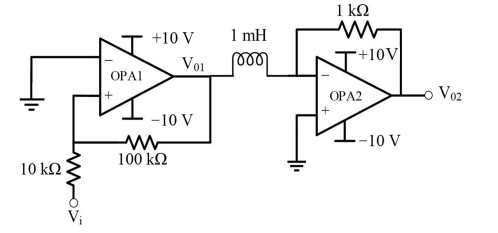
Assume that the initial inductor current is 0 A. The input voltage ($V_i$) is a triangular signal with peak voltages of $\pm 2$ V and time period of 8 $\mu$s. Which one of the following statements is true?
To identify the correct statement, we analyze the two operational amplifier stages separately: the first as a Schmitt trigger and the second as an integrator.
1. Analysis of OPA1 (Schmitt Trigger)
OPA1 is configured as a non-inverting Schmitt trigger with positive feedback. The voltage at the non-inverting terminal (\(V_+\)) is determined by the voltage divider between \(V_i\) and \(V_{o1}\):
$$V_+ = \frac{V_i \cdot 100\text{k}\Omega + V_{o1} \cdot 10\text{k}\Omega}{100\text{k}\Omega + 10\text{k}\Omega}$$
The op-amp switches its output when \(V_+\) crosses the voltage at the inverting terminal (which is \(0\text{ V}\)). Setting \(V_+ = 0\):
$$100 V_i + 10 V_{o1} = 0 \implies 10 V_i = -V_{o1} \implies V_i = -\frac{V_{o1}}{10}$$
Given the saturation voltages \(V_{sat} = \pm 10\text{ V}\):
- If \(V_{o1} = -10\text{ V}\), the switching threshold is \(V_i = +1\text{ V}\).
- If \(V_{o1} = +10\text{ V}\), the switching threshold is \(V_i = -1\text{ V}\).
The input \(V_i\) is a triangular wave with a peak of \(\pm 2\text{ V}\) and a period of \(8\text{ }\mu\text{s}\). The slope of the ramp is:
$$\text{Slope} = \frac{\Delta V}{\Delta t} = \frac{2\text{ V}}{2\text{ }\mu\text{s}} = 1\text{ V/}\mu\text{s}$$
If \(V_i = 0\) at \(t = 0\), it reaches the threshold of \(1\text{ V}\) at \(t = 1\text{ }\mu\text{s}\). Thus, the switching of \(V_{o1}\) is delayed by \(1\text{ }\mu\text{s}\) relative to the zero-crossing of \(V_i\).
2. Analysis of OPA2 (Integrator)
OPA2 is an inverting integrator using an inductor (\(L = 1\text{ mH}\)) and a resistor (\(R_f = 1\text{ k}\Omega\)). Due to the virtual ground at the inverting input:
$$V_{o1} = L \frac{di_L}{dt} \implies i_L = \frac{1}{L} \int V_{o1} dt$$
The output voltage is given by \(V_{o2} = -i_L \cdot R_f\), so:
$$V_{o2} = -\frac{R_f}{L} \int V_{o1} dt$$
Since \(V_{o1}\) is a square wave, its integral is a triangular wave. We check if the output exceeds the saturation limits (\(\pm 10\text{ V}\)):
$$\Delta V_{o2} = \left| -\frac{1000}{10^{-3}} \int_{0}^{4\mu\text{s}} 10 \, dt \right| = 10^6 \times (10 \times 4 \times 10^{-6}) = 40\text{ V}$$
The theoretical peak-to-peak swing is \(40\text{ V}\), but the op-amp saturates at \(\pm 10\text{ V}\) (total range of \(20\text{ V}\)). Therefore, the triangle wave will be clipped at the saturation levels, resulting in a trapezoidal waveform.
Conclusion
Combining the results from both stages:
- \(V_{o1}\) is delayed by \(1\text{ }\mu\text{s}\) relative to \(V_i\).
- \(V_{o2}\) is a trapezoidal waveform.
Important Questions from Op-Amp and Its Applications
Identify the circuit which is not the application of op-amp.
A circuit whose output is proportional to the difference between the input signals is considered to be which type of amplifier?
What is the ideal input resistance of an Op-amp (operational amplifier)?
Which of the following Op-Amp (operational amplifier) circuit configurations primarily operates in a non-linear mode?
Which type of multivibrator is commonly used for pulse stretching or generating a single output pulse of a predetermined duration upon receiving an input trigger?


