
The Nyquist plot of a system is given in the figure below. Let $\omega_P$, $\omega_Q$, $\omega_R$, and $\omega_S$ be the positive frequencies at the points P, Q, R, and S, respectively. Which one of the following statements is TRUE?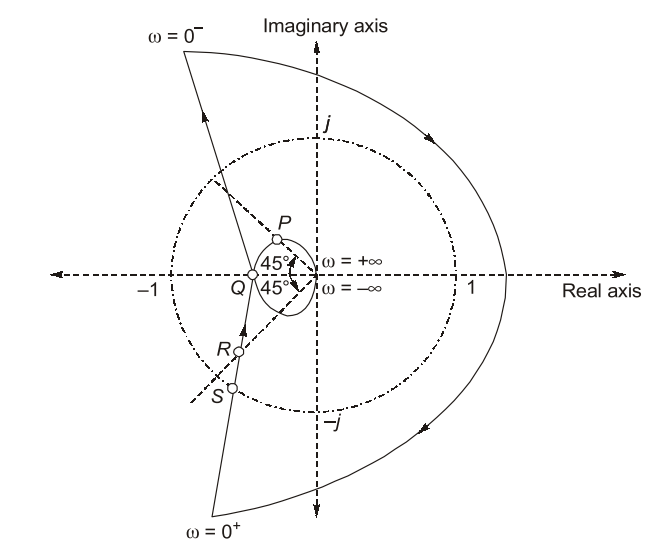
$\omega_S$ is the gain crossover frequency and $\omega_q$ is the phase crossover frequency
To solve this problem, we need to understand the concepts of gain crossover frequency and phase crossover frequency in the context of the Nyquist plot.
In a Nyquist plot:
- The gain crossover frequency is the frequency at which the magnitude of the open-loop transfer function is 1 (or 0 dB). This corresponds to the point where the Nyquist plot intersects the unit circle centered at the origin.
- The phase crossover frequency is the frequency at which the phase angle of the transfer function is -180°. This corresponds to the point where the Nyquist plot intersects the negative real axis.
From the Nyquist plot provided:
- Point Q is where the plot intersects the negative real axis, which means it's the phase crossover frequency.
- Point S is where the plot intersects the unit circle, indicating it's the gain crossover frequency.
Based on the above analysis, option $\omega_S$ is the gain crossover frequency and $\omega_q$ is the phase crossover frequency is correct.
Important Questions from Nyquist Plot
______indicates not only whether a system is stable, but also its degree of stability and how stability may be imposed if necessary.
In Nyquist plot of a system on adding a pole at s = 0, then plot will -
The Nyquist plot of the transfer function \(G\left( s \right) = \frac{K}{{\left( {{s^2} + 2s + 2} \right)\left( {s + 2} \right)}}\)
Does not encircle the point (–1 + j0) for K = 10 but does encircle the point (-1 + j0) for K = 100 . Then the closed-loop system (having unity gain feedback) is
A closed-loop control system is stable if the Nyquist plot of the corresponding open-loop transfer function
The Nyquist stability criterion and the Routh criterion both are powerful analysis tools for determining the stability of feedback controllers. Identify which of the following statements is FALSE:


