
The least number of squares that must be added so that the line P-Q becomes the line of symmetry is ___________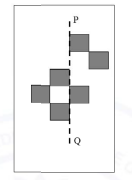
To determine the least number of squares that must be added so that the line $P-Q$ becomes a line of symmetry, we must ensure that for every shaded square on one side of the line, there is a corresponding mirrored shaded square on the opposite side at the same horizontal level and distance from the line.
Step-by-Step Analysis
1. Identify Existing Squares
By observing the provided image, we can categorize the shaded squares based on their position relative to the line $P-Q$:
- Top Section (Right Side): There are 2 squares on the right side of the line $P-Q$. To make the figure symmetric, we need to add their mirror images on the left side.
- Requires 2 additional squares on the left.
- Bottom Cluster (Left Side): Looking at the cluster in the middle-bottom region, there are squares on the left forming a "cross" shape. In the standard version of this problem (from the GATE 2021 exam), the cluster consists of 4 squares on the left that do not have existing counterparts on the right.
- Specifically, the squares on the left at different rows and columns need their mirrors on the right side.
- Requires 4 additional squares on the right.
2. Total Squares to be Added
For the line $P-Q$ to be the axis of symmetry, we must mirror all unmatched squares:
$$ \text{Total squares to add} = (\text{Mirrors for right-side squares}) + (\text{Mirrors for left-side squares}) $$ $$ \text{Total squares to add} = 2 + 4 = 6 $$
3. Visual Verification
If we assume a grid coordinate system where the line $P-Q$ is the vertical axis ($x=0$), and squares are centered at integer distances $(\pm 0.5, \pm 1.5, ...)$:
- The 2 squares at the top right (e.g., at $x=0.5$ and $x=1.5$) need 2 squares at $x=-0.5$ and $x=-1.5$.
- The 4 squares in the left cluster (e.g., at $x=-0.5, y=3; x=-0.5, y=4; x=-1.5, y=4; x=-0.5, y=5$) need 4 squares at corresponding positions on the right ($x=0.5, y=3; x=0.5, y=4; x=1.5, y=4; x=0.5, y=5$).
Conclusion
The least number of squares that must be added is 6.
Correct Option: 6
Important Questions from Mirroring of Shapes
Examples of mirror and water reflections are shown in the figures below:
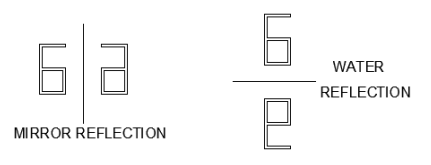
An object appears as the following image after first reflecting in a mirror and then reflecting on water.
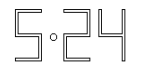
The original object is
A line of symmetry is defined as a line that divides a figure into two parts in a way such that each part is a mirror image of the other part about that line.
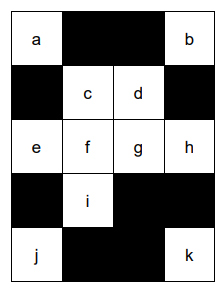
The figure below consists of 20 unit squares arranged as shown. In addition to the given black squares, upto 5 more may be coloured black. Which one among the following options depicts the minimum number of boxes that must be coloured black to achieve two lines of symmetry? (The figure is representative)
- In a CAD package, mirror image of a 2D point P(5,10) is to be obtained about a line which passes through the origin and makes an angle of 45° counterclockwise with the X-axis. The coordinates of the transformed point will be
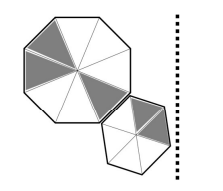
For the picture shown above, which one of the following is the correct picture representing reflection with respect to the mirror shown as the dotted line?
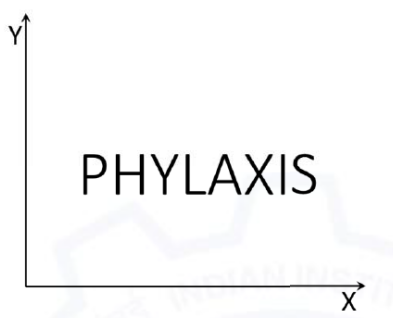
The mirror image of the above text about the X-axis is


