
The igneous rock falling in the shaded field of the figure below is 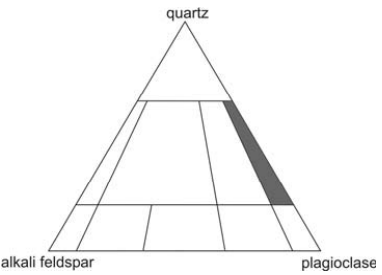
To identify the igneous rock falling in the shaded field of the given diagram, we must understand the composition represented by the QAPF diagram for classifying plutonic (intrusive) rocks. This diagram helps in determining the type of rock based on the relative proportions of quartz (Q), alkali feldspar (A), and plagioclase feldspar (P).
The QAPF diagram is divided into multiple fields, each corresponding to a specific type of igneous rock. The top corner represents quartz (Q), the bottom left corner represents alkali feldspar (A), and the bottom right corner represents plagioclase feldspar (P).
The shaded area in the diagram is located towards the plagioclase-rich side, indicating a higher portion of plagioclase feldspar relative to alkali feldspar and quartz.
Based on the location of the shaded area in the QAPF diagram, it matches with the field designated for tonalite, which is characterized by low quartz content, similar alkali feldspar, and a high percentage of plagioclase.
Other Options:
- Granite: Typically has higher quartz and alkali feldspar content.
- Syenite: Has more alkali feldspar and less quartz.
- Monzonite: Contains similar amounts of alkali and plagioclase feldspar but less quartz.
Hence, the correct answer is tonalite, as it corresponds with the composition indicated by the shaded area in the QAPF diagram.
Important Questions from Igneous Petrology (Classification, Forms, Textures, Genesis)
- The given table shows modal volume percentage of quartz, alkali feldspar and plagioclase in coarse-grained rocks, X and Y. Which of the following rock names of X and Y are CORRECT according to the IUGS classification?
Mineral X (volume %) Y (volume %) Quartz 15 25 Plagioclase 20 60 Alkali feldspar 65 15 - Which one of the following is a mafic volcanic rock?
Match the following igneous textures in Group-I with their definitions in Group-II.
Group-I
Group-II
P Vitrophyre 1 Alkali feldspar rimmed by plagioclase Q Rapakivi 2 Aggregate of radially arrayed, needle-like crystals of plagioclase with or without clinopyroxene R Ocelli 3 Sub-parallel skeletal, platy olivine and/or pyroxene S Spinifex 4 Large phenocrysts within a glassy matrix - Match the rock types in Group-I with their most likely corresponding lithospheric / tectonic settings of formation in Group-II
Group-I Group-II P. Boninite 1. Continental anorogenic Q. Lamproite 2. Island-arc R. Phonolite 3. Continental collision S. Leucogranite 4. Intraplate oceanic - The mole percentages of SiO$_2$, Al$_2$O$_3$ and K$_2$O in a granitic rock are 84.21, 7.89 and 7.89, respectively. The molar proportion (in %) of K-feldspar in the rock is ________ [ round off to one decimal place]


