
The I-V characteristics of three types of diodes at the room temperature, made of semiconductors X, Y and Z, are shown in the figure. Assume that the diodes are uniformly doped and identical in all respects except their materials. If $E_{gX}$, $E_{gY}$ and $E_{gZ}$ are the band gaps of X, Y and Z, respectively, then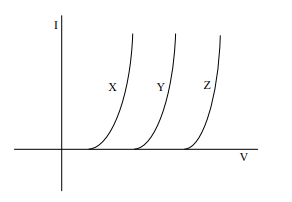
$E_{gX} < E_{gY} < E_{gZ}$
The problem involves understanding the relationship between the band gap energy of semiconductors and the forward voltage drop (threshold voltage) observed in diode characteristics.
For a semiconductor diode, the forward voltage drop (threshold voltage) is related to the band gap energy (\(E_g\)) of the material. Generally, the larger the band gap, the higher the threshold voltage required for current conduction. This is because a larger band gap implies that the material requires more energy to move electrons from the valence band to the conduction band.
In the given diagram, we have three diodes made from semiconductors X, Y, and Z, each with distinct I-V characteristics. Analysis of the graph shows:
- Diode X has the least forward voltage drop.
- Diode Y has a moderate forward voltage drop.
- Diode Z has the highest forward voltage drop.
This suggests that:
- \(E_{gX}\) is the smallest because Diode X conducts at the lowest voltage.
- \(E_{gY}\) is greater than \(E_{gX}\) but less than \(E_{gZ}\).
- \(E_{gZ}\) is the largest as it requires the highest voltage for conduction.
Thus, the correct relationship among the band gaps is:
\(E_{gX} < E_{gY} < E_{gZ}\)
Therefore, the correct answer is: \(E_{gX} < E_{gY} < E_{gZ}\)
Important Questions from Energy Band Gap
Which one of the following element has Forbidden energy band approximately equal to 6 eV?
The bandgap of Si at 300 K is:
For an intrinsic semiconductor at temperature 𝑇 = 0 𝐾, which of the following statement is true?
- Which of the following is correctly ordered according to the ascending order of band gap energy?
Which of the following is an intrinsic semiconductor?


