
The Fourier series representation of a square wave is shown in the figure below. The fluctuations seen near $x = \pm 1$ are named after which one of the following scientists?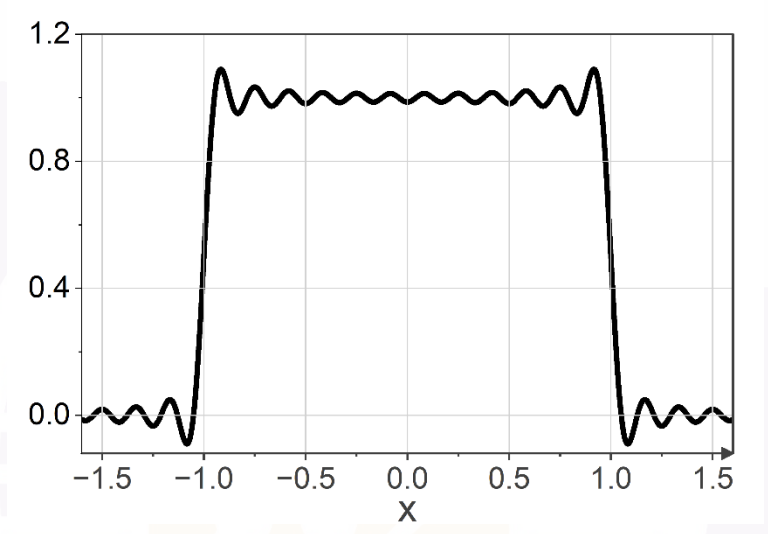
The Fourier series representation of a square wave can exhibit fluctuations at points of discontinuity. These fluctuations are known as the Gibbs phenomenon.
The Gibbs phenomenon refers to the overshoot (or "ringing") observed in the Fourier series approximation of a function that has a discontinuity, such as a square wave. It is specifically pronounced near points of discontinuity, where the series does not perfectly converge but rather oscillates as it approaches the limit. This effect is named after J. Willard Gibbs, who studied this behavior in the context of Fourier analysis.
Let's analyze why this phenomenon is not attributed to the other options:
- Cauchy: Known for contributions to analysis and probability, but not directly related to this overshoot in Fourier series.
- Fourier: Although he developed Fourier series, the phenomenon itself is named after Gibbs.
- Laplace: Known for work on transformations and probability, but again not related to this specific phenomenon.
Therefore, the correct answer is Gibbs.
Important Questions from Fourier Series
If we use the Fourier transform ϕ(x, y) = \(\int {{{\rm{e}}^{{\rm{ikx}}}}} {ϕ _{\rm{k}}}\left( {\rm{y}} \right){\rm{dk}}\) to solve the partial differential equation \({\rm{ - }}\frac{{{\partial ^2}ϕ \left( {x,y} \right)}}{{\partial {y^2}}}\, - \,\frac{1}{{{y^2}}}\frac{{{\partial ^2}ϕ \left( {x,y} \right)}}{{\partial {x^2}}} + \frac{{{m^2}}}{{{y^2}}}ϕ \left( {x,y} \right) = 0\) in the half-plane {(x, y) : -∞ < x < ∞, 0 < y < ∞} the Fourier modes ϕ k(y) depend on y as y α and y β . The values of α and β are
When a time-domain signal is converted into its Fourier representation, which of the following is/are conserved?
I. Energy
II. Power
The trigonometric Fourier series of a periodic time function can have
The Fourier series expansion of x3 in the interval −1 ≤ x < 1 with periodic continuation has
The Fourier series to represent x-x2 for –π ≤ x ≤ π is given by \(x - {x^2} = \frac{{{a_0}}}{2} + \mathop \sum \limits_{n = 1}^\infty {a_n}cosnx + \mathop \sum \limits_{n = 1}^\infty {b_n}sinnx\)
The value of a0 (round off to two decimal places), is


