
The following figure shows the position of a needle at its lowest position during needlepunching operation. If P, Q and R are barbs on the needle, then which is the correct order of barbs in terms of workload?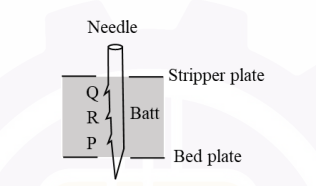
In needlepunching operations, the needle penetrates through the fibrous batt, and barbs present on the needle perform the work of entangling fibers to create the fabric. The arrangement and workload of these barbs are crucial in determining their efficiency and the quality of the resulting fabric.
The image shows three barbs on a needle at the positions labeled P, Q, and R. To determine the order of these barbs in terms of workload during the operation, we need to consider their role during the penetration and withdrawal of the needle:
- During penetration, the lowest barb (P) will engage first with the fibers, starting the entanglement process. It carries the most workload as it is the first point of contact.
- The barb at position R will engage next in line after P, further entangling the fibers. It has a lesser workload compared to P as some entanglement work is already done by P.
- Finally, the barb at position Q will engage last, carrying the least amount of workload since most of the entanglement is completed by P and R.
Thus, the workload order of the barbs from highest to lowest is P > R > Q.
Therefore, the correct answer is: P > R > Q.
Important Questions from FABR Nonwoven Fabric Technology Bonding Methods
- The bonding process followed for production of highloft nonwoven is
Consider the following components of a needle:
P. Shank
Q. Beard
R. Barb
S. Latch
The combination of correct components of a needle in a needle punching nonwoven machine isA needle loom, having a needle board with 2000 needles/m, is operating at a stroke frequency of 2000 strokes/min and producing a needle-punched nonwoven fabric at 5 m/min. The punch density, in number of punches per $cm^2$, is ______________
- The punch density of a needle-punched nonwoven fabric is 50 punches/cm². If the stroke frequency of needle bed is doubled and the fabric delivery speed is halved, then the punch density (punches/cm²) would be
- In needle punching process, higher punch density CAN NOT cause


