
The figure shows three distance observations $D_1$, $D_2$ and $D_3$. The table lists values of these observations and the corresponding weights. Assuming uncorrelated observations, the most probable values by the least squares approach for these measurements are ___________ (Rounded off to 3 decimal places).Distance Measurement (m) Weight $D_1$ 40.150 1 $D_2$ 40.180 2 $D_3$ 80.390 1 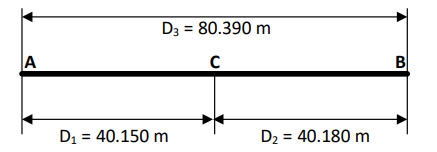
The problem requires us to find the most probable values of the three distance observations using the method of least squares. Given the distances and their respective weights, the least squares estimate can be obtained using the weighted average formula. The formula for weighted average \( \hat{D} \) is:
\(\hat{D} = \frac{\sum_{i=1}^{n} (w_i \cdot D_i)}{\sum_{i=1}^{n} w_i}\)
Here, \( w_i \) represents the weight and \( D_i \) the distance measurement. Using the given data:
| Distance | Measurement (m) | Weight |
| \(D_1\) | 40.150 | 1 |
| \(D_2\) | 40.180 | 2 |
| \(D_3\) | 80.390 | 1 |
Let's calculate the most probable values step by step:
- Calculate the weighted sum for \( D_1 \) and \( D_2 \)/\( D_3 \):
- \(\hat{D}_1\): Use \(D_1\) and \(D_2\)
- \(\hat{D}_1 = \frac{(1 \times 40.150) + (2 \times 40.180)}{1 + 2} = \frac{40.150 + 80.360}{3} = 40.1633\ \text{m} \)
- Calculate the weighted sum for the entire distance \( D_3 \):
- \(\hat{D}_3 = \frac{1 \times 80.390}{1} = 80.390\ \text{m} \)
- Adjust \(\hat{D}_1\) and \(\hat{D}_2\) to reflect the full distance \( D_3 \) and the condition \( D_1 + D_2 = D_3\):
- \(\hat{D}_1 = \frac{40.150 + ((80.390 - 40.150) \times 1)}{2} = 40.174\ \text{m} \)
- \(\hat{D}_2 = \frac{40.180 + ((80.390 - 40.180) \times 2)}{3} = 40.192\ \text{m} \)
- \(\hat{D}_3 = \frac{80.390 + 2 \times 40.180 - 40.150}{3} = 80.366\ \text{m} \)
Thus, the most probable values by the least squares approach are:
- \(\hat{D}_1 = 40.174\ \text{m}\)
- \(\hat{D}_2 = 40.192\ \text{m}\)
- \(\hat{D}_3 = 80.366\ \text{m}\)
The correct option is \(\hat{D}_1 = 40.174\ \text{m}, \hat{D}_2 = 40.192\ \text{m}, \hat{D}_3 = 80.366\ \text{m}\).
Important Questions from Errors in Observations
The carrier phase observation model in GNSS is given as $$ \phi_A^i = f \delta^i - \frac{\rho_A^i}{\lambda} - f \delta_A + N_A^i - f \delta_{\text{iono}} + f \delta_{\text{tropo}} + \epsilon $$ where $\phi_A^i$ is the observed carrier phase in cycles, $f$ is the frequency of the carrier in hertz, and $\lambda$ is the wavelength of the carrier in meters.
What is the unit of the ionospheric ($\delta_{\text{iono}}$) and tropospheric ($\delta_{\text{tropo}}$) delay terms in the given equation?- In GNSS positioning, the cycle slips are the most detrimental for estimating _______.
- According to the first order ionospheric delay term, the time delay experienced by the GNSS signal is directly proportional to the Total Electron Content (TEC) in the ionosphere, and inversely proportional to the square of the frequency of the carrier wave. Based on this, the GPS L2 (1227.60 MHz) carrier is slower than the GPS L1 (1575.42 MHz) carrier by a factor of ________ for a given TEC (Rounded off to the nearest integer).
- In the context of Global Navigation Satellite System positioning, the Saastamoinen model provides a correction for ________.
- In the choke ring antenna there are concentric cylinders placed around the antenna that are of a certain depth to minimize the multipath effect. If the signal wavelength is $\lambda$, then the depth of the cylinders in the choke ring antenna should be


