
The figure below shows the front and rear view of a disc, which is shaded with identical patterns. The disc is flipped once with respect to any one of the fixed axes 1-1, 2-2 or 3-3 chosen uniformly at random.
What is the probability that the disc DOES NOT retain the same front and rear views after the flipping operation? 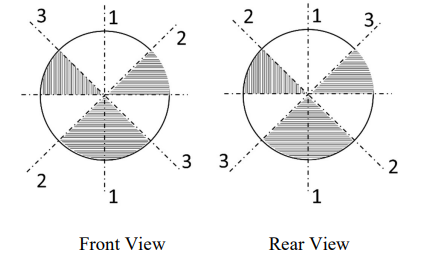
Solution Explained
To solve this problem, we need to analyze the symmetries of the disc's pattern and determine how it changes under three different flipping operations. A view is "retained" if, after flipping the disc over an axis, the pattern visible from the front is identical in shape, position, and hatching type to the original front view.
1. Identifying the Patterns on Both Sides
From the provided images, we can characterize the patterns on the front and rear faces of the disc. Let's define the positions relative to the viewer (e.g., using a clock or compass directions):
- Front View:
- Left (9 o'clock): Shaded with Vertical (\(V\)) lines.
- Right (3 o'clock): Shaded with Horizontal (\(H\)) lines.
- Bottom (6 o'clock): Shaded with Horizontal (\(H\)) lines.
- Top (12 o'clock): Unshaded (Blank).
- Rear View:
- The problem states the patterns are "identical". Looking at the "Rear View" image, the layout is exactly the same as the front: Left is \(V\), Right is \(H\), Bottom is \(H\).
2. Mapping Physical Locations
When you look at the rear of a disc, the physical part that was on your left when looking at the front is now on your right. Thus:
- Physical Left side: Front face has \(V\), Rear face has \(H\) (since Rear-View-Right is \(H\)).
- Physical Right side: Front face has \(H\), Rear face has \(V\) (since Rear-View-Left is \(V\)).
- Physical Bottom side: Front face has \(H\), Rear face has \(H\) (since Rear-View-Bottom is \(H\)).
3. Analyzing the Flipping Operations
We test each of the three fixed axes (1-1, 2-2, 3-3) to see if the resulting front view matches the original.
- Flip over Axis 1-1 (Vertical):
This flip swaps the Left and Right physical positions and brings the Rear face to the front.
- New Front-Left = Old Rear-Right = \(V\) (Matches original Front-Left).
- New Front-Right = Old Rear-Left = \(H\) (Matches original Front-Right).
- New Front-Bottom = Old Rear-Bottom = \(H\) (Matches original Front-Bottom).
- View is RETAINED.
- Flip over Axis 2-2 or 3-3 (Diagonal):
These axes are not lines of symmetry for the pattern's layout. Specifically, the blank sector at the top is not centered on these axes.
- Flipping over a diagonal axis maps the unshaded top sector to a position that was previously shaded (like the left or right side), and vice versa.
- Because the distribution of shaded vs. unshaded regions changes, the view cannot be the same.
- View is NOT RETAINED for both axis 2-2 and axis 3-3.
4. Calculating the Probability
There are 3 possible axes chosen uniformly at random:
- Total outcomes = \(3\)
- Number of outcomes where the view IS NOT retained = \(2\) (Axes 2-2 and 3-3)
𝑃 ( Not Retaining View ) = Favorable Outcomes/Total Outcomes = 2/3
Important Questions from Probability
The probability of being 53 Sundays in year 2020 is-
Three dice are thrown randomly. The probability of coming 3 in at least one die is
The probability of having 53 Tuesdays in an ordinary year is:
When two dice are tossed simultaneously, the probability that the sum of the numbers appearing on both the dice is 8 will be
How many 3 - digit numbers can be formed from the digits 2, 3, 5, 6, 7 and 9, which are divisible by 5 and none of the digits is repeated?


