
The feedback system shown below oscillates at 2 rad/s when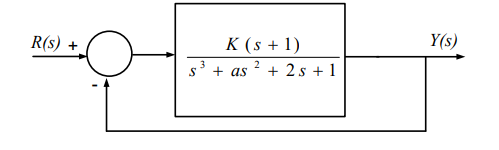
The problem requires finding the values of the gain $K$ and the parameter $a$ such that the system is marginally stable (oscillates) at the frequency $\omega = 2 \text{ rad/s}$.
1. Form the Closed-Loop Characteristic Equation
The open-loop transfer function is $G(s) = \frac{K(s + 1)}{s^3 + a s^2 + 2s + 1}$. The characteristic equation is $1 + G(s) = 0$:
$$s^3 + a s^2 + 2s + 1 + K(s + 1) = 0$$
Grouping powers of $s$:
$$s^3 + a s^2 + (2 + K)s + (1 + K) = 0 \quad (\text{Eq. 1})$$
2. Apply Routh-Hurwitz Criterion for Marginal Stability
For marginal stability, the Routh array must have a row of zeros, and all preceding rows must be non-zero and positive. We construct the Routh array:
| Row | $s^3$ | $s^1$ |
|---|---|---|
| $s^3$ | 1 | $2 + K$ |
| $s^2$ | $a$ | $1 + K$ |
| $s^1$ | $b_1$ | 0 |
The coefficient $b_1$ is:
$$b_1 = \frac{a(2 + K) - 1(1 + K)}{a}$$
For oscillation, we set $b_1 = 0$ (assuming $a \neq 0$):
$$a(2 + K) - (1 + K) = 0$$ $$2a + aK - 1 - K = 0 \quad (\text{Eq. 2})$$
3. Use the Oscillation Frequency ($\omega = 2 \text{ rad/s}$)
If $b_1 = 0$, the auxiliary equation $A(s)$ is formed from the $s^2$ row coefficients, and its roots must be $\pm j\omega$:
$$A(s) = a s^2 + (1 + K) = 0$$
Substitute $s = j\omega = j2$:
$$a (j2)^2 + (1 + K) = 0$$ $$-4a + 1 + K = 0$$ $$K = 4a - 1 \quad (\text{Eq. 3})$$
4. Solve for $a$ and $K$
Substitute $K$ from Eq. 3 into Eq. 2:
$$2a + a(4a - 1) - 1 - (4a - 1) = 0$$ $$2a + 4a^2 - a - 1 - 4a + 1 = 0$$ $$4a^2 - 3a = 0$$ $$a(4a - 3) = 0$$
Since $a=0$ makes the characteristic equation $s^3 + (2+K)s + (1+K) = 0$ unstable (missing $s^2$ term), we choose the non-zero root:
$$4a = 3 \quad \Rightarrow \quad a = 0.75$$
Substitute $a = 0.75$ back into Eq. 3 to find $K$:
$$K = 4(0.75) - 1 = 3 - 1$$ $$K = 2$$
5. Conclusion
The system oscillates at $2 \text{ rad/s}$ when $K = 2$ and $a = 0.75$.
The correct option is Option 1.
Important Questions from Stability Analysis
For a stable system, poles of the transfer function
If a system has simple poles lying on the imaginary axis and no poles to its right, it is
The number of sign changes in the first column of the Routh's array denotes:
The closed loop transfer function of a system is \(T\left( s \right) = \frac{{\left( {s + 8} \right)\left( {s + 6} \right)}}{{{s^5} - {s^4} + 4{s^3} - 4{s^2} + 3s - 2}}\). The function of poles in RHP and LHP are
The margin between actual gain and critical gain is a measure of


