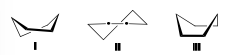
Understanding Chair Conformations
The molecule is trans-1,2-dimethylcyclohexane. In a cyclohexane ring, substituents can occupy either axial or equatorial positions. For a trans-1,2-disubstituted cyclohexane, the two possible chair conformations involve:
- Diequatorial Conformation: Both methyl groups ($CH_3$) are equatorial. This conformation generally has lower steric strain.
- Diaxial Conformation: Both methyl groups ($CH_3$) are axial. This conformation experiences significant steric strain due to interactions between the axial groups.
Analyzing Gauche Interactions
The question asks for the difference in the number of gauche interactions between the diaxial and diequatorial conformations. Gauche interactions refer to torsional strain arising from a 1,2-relationship between groups with a dihedral angle close to 60 degrees. In the context of cyclohexane chair conformations, we evaluate the interactions involving the substituents:
- Diequatorial Conformation: The two equatorial methyl groups are relatively far apart and oriented outwards from the ring. They do not experience significant steric repulsion or gauche interactions with each other or the ring hydrogens in a way that adds substantial strain. Therefore, the number of relevant gauche interactions is considered 0.
- Diaxial Conformation: The two axial methyl groups are positioned on the same side of the ring's average plane, close to the axis. This leads to significant steric repulsion. This repulsive strain is often quantified. In many models, the strain associated with the diaxial arrangement of substituents at the 1,2-position is considered equivalent to 3 gauche interactions. This count reflects the unfavorable Me-Me gauche interaction and potentially other significant steric interactions modeled as gauche.
Calculating the Difference
The difference in the number of gauche interactions is the value in the diaxial conformation minus the value in the diequatorial conformation.
We use LaTeX for the calculation:
$ \text{Difference} = (\text{Gauche interactions in Diaxial}) - (\text{Gauche interactions in Diequatorial}) $
$ \text{Difference} = 3 - 0 $
$ \text{Difference} = 3 $
The difference in the number of gauche interactions is 3.
Important Questions from Cyclohexane Conformations
The correct order of stability for the following conformations of cyclohexane is