
Question
The correct statement about the following quaternary ammonium ion is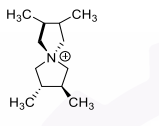
The correct answer is
It has $S_4$-symmetry, hence achiral
The question involves analyzing the symmetry properties of a quaternary ammonium ion. Symmetry elements help determine whether a molecule is chiral or achiral. Let's analyze each option:
- $C_2$-symmetry: A molecule with $C_2$ symmetry means it can be rotated 180 degrees around an axis to coincide with itself. However, the presence of $C_2$ symmetry alone does not ensure chirality.
- $S_4$-symmetry: This means the molecule has an improper rotation axis, specifically a combination of a rotation by 90 degrees followed by a reflection. If a molecule has $S_4$ symmetry, it is achiral. Therefore, this aligns with the correct answer.
- No symmetry: If a molecule lacks any symmetry, it generally indicates chirality. However, this option is not true for the given molecule.
- Centre of symmetry: A center of symmetry implies that each part of the molecule has an identical part directly opposite to it. This leads to achirality, but the given molecule does not have a center of symmetry.
Thus, based on the above explanations, the correct answer is that the given quaternary ammonium ion has \(S_4\)-symmetry, hence it is achiral.
Was this answer helpful?
Important Questions from Chirality
Among the following, the chiral compound is
Need Expert Advice?


