
Steps involved in computation of tax on agricultural income in India are followed in which sequence? A. Add basic exemption limit to Net agriculture income and calculate tax B. Deduct rebate u/s 87A from the total income C. Add Health Cess D. Add Agricultural and Non-agriculture income and calculate tax on total income E. Calculate difference of tax in both computations Choose the correct answer from the options given below
D, A, E, B, C
Steps for Calculating Tax on Income with Agricultural Income
When an individual in India has both agricultural income and non-agricultural income, and certain conditions are met (net agricultural income exceeds ₹5,000 and total income exceeds the basic exemption limit), the income tax is computed using a process called partial integration of agricultural income.
The question asks for the correct sequence of steps involved in this tax computation. Let's look at the given steps:
- A. Add basic exemption limit to Net agriculture income and calculate tax
- B. Deduct rebate u/s 87A from the total income
- C. Add Health Cess
- D. Add Agricultural and Non-agriculture income and calculate tax on total income
- E. Calculate difference of tax in both computations
The standard procedure for partial integration of agricultural income involves calculating tax in two stages and then finding the difference. Let's arrange the steps in the logical flow of this computation:
Correct Sequence of Tax Computation Steps
The correct sequence of steps for computing tax when agricultural income is involved is as follows:
- Step D: Add Agricultural and Non-agriculture income and calculate tax on total income.
First, you calculate the tax on the aggregate income, which is the sum of non-agricultural income and net agricultural income, using the applicable income tax slab rates. This gives you a preliminary tax amount on the total income. - Step A: Add basic exemption limit to Net agriculture income and calculate tax.
Next, you calculate the tax on a sum equal to the net agricultural income plus the basic exemption limit (applicable for the taxpayer). This calculation uses the same slab rates as in Step D. This step essentially determines the tax that would be attributable to the agricultural income combined with the exempt portion of income. - Step E: Calculate difference of tax in both computations.
The actual tax liability on the non-agricultural income is found by subtracting the tax calculated in Step A from the tax calculated in Step D. \(\text{Tax on Non-agricultural Income} = \text{Tax from Step D} - \text{Tax from Step A}\). - Step B: Deduct rebate u/s 87A from the total income.
After calculating the tax on non-agricultural income, if the taxpayer is eligible for a rebate under section 87A (e.g., a resident individual whose total income does not exceed ₹5 lakh for Assessment Year 2024-25), this rebate is deducted from the tax liability. - Step C: Add Health Cess.
Finally, a Health and Education Cess (currently 4%) is levied on the tax amount remaining after deducting any rebate. This cess is added to arrive at the final tax payable.
Therefore, the correct sequence of the steps is D, A, E, B, C.
| Sequence | Step | Description |
|---|---|---|
| 1 | D | Calculate tax on (Non-agricultural Income + Agricultural Income) |
| 2 | A | Calculate tax on (Basic Exemption Limit + Agricultural Income) |
| 3 | E | Subtract tax from Step A from tax from Step D |
| 4 | B | Deduct rebate u/s 87A (if applicable) |
| 5 | C | Add Health and Education Cess |
Revision Table: Key Tax Calculation Steps with Agricultural Income
| Step Order | Corresponding Action |
|---|---|
| 1st | Add Agricultural and Non-agriculture income and calculate tax on total income |
| 2nd | Add basic exemption limit to Net agriculture income and calculate tax |
| 3rd | Calculate difference of tax in both computations |
| 4th | Deduct rebate u/s 87A from the total income |
| 5th | Add Health Cess |
Additional Information on Agricultural Income Taxation
- Agricultural income is generally exempt from income tax in India under Section 10(1) of the Income Tax Act, 1961.
- However, for the purpose of determining the tax rate on non-agricultural income, agricultural income is partially integrated with non-agricultural income for individuals, Hindu Undivided Families (HUFs), Association of Persons (AOPs), Body of Individuals (BOIs), and Artificial Juridical Persons, provided certain conditions are met.
- The conditions for partial integration are:
1. The net agricultural income exceeds ₹5,000 during the previous year.
2. The total income (excluding net agricultural income) exceeds the basic exemption limit applicable to the taxpayer. - Basic exemption limits vary based on the age of the individual taxpayer.
- Rebate under Section 87A is available to a resident individual whose total income (after all deductions but before agricultural income integration) does not exceed a specified limit (e.g., ₹5 lakh for AY 2024-25). The maximum rebate is ₹12,500 or the amount of tax, whichever is less.
- Health and Education Cess is currently levied at the rate of 4% on the income tax plus surcharge (if any).
Important Questions from Miscellaneous
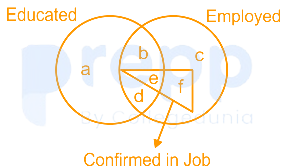
Read the given figure and find the region representing persons who are educated and employed but not confirmed in job.
The magazine in which Mahatma Gandhi mentioned what he wanted the Constitution to do is:
Which gas shields the surface of the earth from ultraviolet radiation from the sun?
Which event is marked as an Intangible Cultural Heritage of Humanity by UNESCO?
Who has been conferred with the rank of the Commander of the Order of the British Empire in 2018?


