
Starting from the same point at the same time, A and B run on a 3600 m circular track with speeds of 4 m/s and 6 m/s, clockwise. After A completes the first round on the track, she reverses direction and runs anticlockwise. After how many seconds of starting the run would they cross for the first time?
1080
Understanding the Circular Track Problem
This problem involves two runners, A and B, on a circular track. They start at the same point and time, but A changes direction after completing the first round. We need to find the exact time from the start when they meet for the first time.
Here are the key details:
- Track length: 3600 m
- A's initial speed: 4 m/s (clockwise)
- B's speed: 6 m/s (clockwise)
- A reverses direction to anticlockwise after completing the first 3600 m.
Calculating A's First Round Time
First, let's figure out how long it takes A to complete one full round of the track, as this is when A changes direction.
Time = Distance / Speed
\( \text{Time for A's first round} = \frac{\text{Track length}}{\text{A's speed}} \)
\( \text{Time} = \frac{3600 \text{ m}}{4 \text{ m/s}} = 900 \text{ seconds} \)
So, at \(t = 900\) seconds from the start, A is back at the starting point.
Positions of A and B at 900 Seconds
At \(t = 900\) seconds:
- A is at the starting point (completed 1 round).
- B has been running clockwise for 900 seconds at 6 m/s.
Distance covered by B = B's speed \(\times\) Time
\( \text{Distance covered by B} = 6 \text{ m/s} \times 900 \text{ s} = 5400 \text{ m} \)
To find B's position on the circular track, we find the remainder after dividing the distance covered by the track length:
\( 5400 \text{ m} = 1 \times 3600 \text{ m} + 1800 \text{ m} \)
This means B has completed 1 full round and is 1800 m clockwise from the starting point at \(t = 900\) seconds.
Motion After 900 Seconds
At \(t = 900\) seconds:
- A is at the starting point and begins running anticlockwise at 4 m/s.
- B is at 1800 m clockwise from the starting point and continues running clockwise at 6 m/s.
Now, A is moving anticlockwise from the starting point, and B is moving clockwise from a point 1800 m away clockwise. They are effectively moving towards each other along the track.
The distance between them along the track at this moment is 1800 m (the shorter arc between the starting point and B's position).
Since they are moving towards each other on the circular track (one clockwise, one anticlockwise), their relative speed is the sum of their speeds.
Relative speed = A's speed (anticlockwise) + B's speed (clockwise)
\( \text{Relative speed} = 4 \text{ m/s} + 6 \text{ m/s} = 10 \text{ m/s} \)
Time to Meet After Direction Change
The time it takes for them to meet for the first time after \(t = 900\) seconds is the distance between them divided by their relative speed.
Time to meet = Distance between them / Relative speed
\( \text{Time after 900s to meet} = \frac{1800 \text{ m}}{10 \text{ m/s}} = 180 \text{ seconds} \)
Total Time Until First Meeting
The first meeting happens after A completes the first round and then runs for an additional 180 seconds while B continues running.
Total time = Time for A's first round + Time to meet after 900s
\( \text{Total time} = 900 \text{ s} + 180 \text{ s} = 1080 \text{ seconds} \)
They would cross for the first time 1080 seconds after starting the run.
Important Questions from Miscellaneous
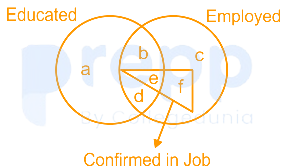
Read the given figure and find the region representing persons who are educated and employed but not confirmed in job.
The magazine in which Mahatma Gandhi mentioned what he wanted the Constitution to do is:
Which gas shields the surface of the earth from ultraviolet radiation from the sun?
Which event is marked as an Intangible Cultural Heritage of Humanity by UNESCO?
Who has been conferred with the rank of the Commander of the Order of the British Empire in 2018?


