
Estimating the Cube Root of 0.99
The question asks us to find the value that is closest to the cube root of 0.99. In mathematical notation, we need to estimate $ \sqrt[3]{0.99} $. We are given four possible options: 0.33, 0.14, 0.99, and 0.45.
Method 1: Logical Approximation
We know that the cube root of 1 is exactly 1, because $ 1 \times 1 \times 1 = 1 $. The number 0.99 is very close to 1.
Since 0.99 is slightly less than 1, its cube root ($\sqrt[3]{0.99}$) should be slightly less than the cube root of 1 (which is 1). This tells us that the answer must be a number close to 1.
Let's examine the given options:
- 0.33
- 0.14
- 0.99
- 0.45
Comparing these options to 1, the value 0.99 is clearly the closest. The other values (0.14, 0.33, and 0.45) are much smaller than 1 and are therefore unlikely to be the cube root of 0.99.
Method 2: Verification by Cubing the Options
To verify our estimation, we can calculate the cube of each option and check which result is closest to the original number, 0.99.
| Option Value | Calculation: (Value)^3 | Approximate Result | Difference from 0.99 |
|---|---|---|---|
| 0.33 | $ (0.33)^3 $ | $ \approx 0.0359 $ | $ |0.99 - 0.0359| \approx 0.9541 $ |
| 0.14 | $ (0.14)^3 $ | $ \approx 0.0027 $ | $ |0.99 - 0.0027| \approx 0.9873 $ |
| 0.99 | $ (0.99)^3 $ | $ \approx 0.9703 $ | $ |0.99 - 0.9703| \approx 0.0197 $ |
| 0.45 | $ (0.45)^3 $ | $ \approx 0.0911 $ | $ |0.99 - 0.0911| \approx 0.8989 $ |
From the table, we can see the difference between 0.99 and the cube of each option. The smallest difference is approximately 0.0197, which occurs when we cube 0.99. This confirms that 0.99 is the value whose cube is closest to 0.99, meaning $\sqrt[3]{0.99}$ is closest to 0.99.
Method 3: Linear Approximation using Calculus (Advanced)
A more precise way to estimate is using linear approximation. Let the function be $ f(x) = \sqrt[3]{x} = x^{1/3} $. We want to find $ f(0.99) $. We choose a nearby point $ a $ where we know the function value and derivative easily, like $ a = 1 $.
The linear approximation formula is:
$ f(x) \approx f(a) + f'(a)(x-a) $
First, find the derivative $ f'(x) $:
$ f'(x) = \frac{d}{dx}(x^{1/3}) = \frac{1}{3}x^{(1/3 - 1)} = \frac{1}{3}x^{-2/3} $
Evaluate $ f(a) $ and $ f'(a) $ at $ a = 1 $:
- $ f(1) = (1)^{1/3} = 1 $
- $ f'(1) = \frac{1}{3}(1)^{-2/3} = \frac{1}{3} \times 1 = \frac{1}{3} $
Now apply the formula with $ x = 0.99 $ and $ a = 1 $:
$ f(0.99) \approx f(1) + f'(1)(0.99 - 1) $
$ f(0.99) \approx 1 + \frac{1}{3}(-0.01) $
$ f(0.99) \approx 1 - \frac{0.01}{3} $
$ f(0.99) \approx 1 - 0.00333... $
$ f(0.99) \approx 0.99666... $
Comparing this more precise estimate ($ \approx 0.9967 $) to the options, we find that 0.99 is the closest value ($ |0.9967 - 0.99| = 0.0067 $).
Conclusion
All methods confirm that 0.99 is the closest value to $\sqrt[3]{0.99}$ among the choices provided.
Important Questions from Simplification (Notes)
- In the Delhi zoo, there are some ducks and rabbits. If the heads are counted there are 160, while the legs are 450. What will be number of ducks in the zoo ?
Identify the number that will replace the question mark in the second equation based on the relationship represented in the first equation.
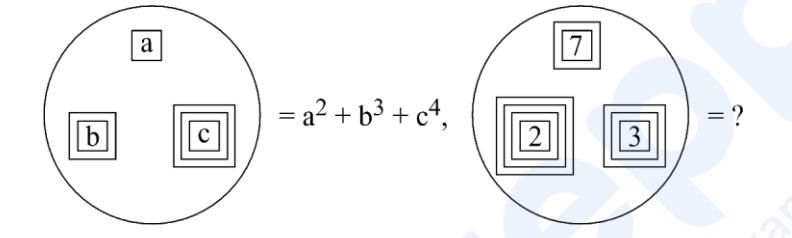
What value should come in the place of question mark (?) in the following equation?
$(0.008\div?) + (0.006 \div 0.03) + (0.008 \div 0.04) =0.5$If 'I' stands for '+', 'J' stands for 'x', 'K' stands for '÷', and 'L' stands for '-', then what will come in place of the question mark (?) in the following equation?
6 K 2 J 4 L 3 I 9 = ?If 'A' stands for '$\div $', 'B' stands for 'x', 'C' stands for '+' and 'D' stands for '-', then what will come in place of the question mark (?) in the following equation?
33 A 3 C 4 B 2 D 4 A 2 = ?


