
Retarding frictional force, $f$, on a moving ball, is proportional to its velocity, $V$. Two identical balls roll down identical slopes (A & B) from different heights. Compare the retarding forces and the velocities of the balls at the bases of the slopes.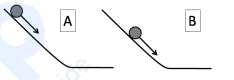
The problem involves two identical balls rolling down identical slopes from different heights. The retarding frictional force, \(f\), is proportional to the velocity \(V\) of the balls.
- Since both balls are identical and roll down identical slopes, the gravitational potential energy at the top will differ due to different heights. The energy conversion is as follows:
\(mgh_A \rightarrow \frac{1}{2}mV_A^2 + \text{frictional work on A}\)
\(mgh_B \rightarrow \frac{1}{2}mV_B^2 + \text{frictional work on B}\)
- Since \(h_A > h_B\), ball A starts with higher potential energy. Therefore, more energy is converted to kinetic energy, and it tends to have a higher velocity at the base.
- The frictional force, \(f\), is given by:
\(f = kV\)
- where \(k\) is a constant of proportionality.
- With \(V_A > V_B\) due to higher initial energy, the frictional force \(f_A\) will also be greater than \(f_B\).
- Thus, the correct option is:
\(f_A > f_B\) ; \(V_A > V_B\)
The reasoning confirms that as the height increases, both velocity and the thus retarding force increase, affirming the chosen option.
Important Questions from Miscellaneous
Unemployment that arises when people are between jobs is known as:
- The spin-parity assignments for the ground and first excited states of the isotope $^{57}_{28}\text{Ni}$, in the single particle shell model, are
- The first excited state of the rotational spectrum of the nucleus $^{238}_{\ 92}\text{U}$ has an energy 45 keV above the ground state. The energy of the second excited state (in keV) is
- A new tyre can be used for at most $90\text{ km}$. What is the maximum distance (in km) that can be covered by a three wheeled vehicle carrying one spare wheel, all four tyres being new?
- If a plant with green leaves is kept in a dark room with only green light ON, which one of the following would we observe?


