
_______ refers to a collaboration between a government, private firms, and universities, which may form the basis of the Science and Technology Park structure
The triple helix model
Understanding the Triple Helix Model in Science and Technology Parks
The question asks about a specific type of collaboration that often forms the foundation for Science and Technology Parks. This collaboration involves three distinct entities: the government, private firms (industry), and universities.
Let's look at the options provided and determine which theoretical model best describes this three-way interaction.
Why the Triple Helix Model is Correct
The Triple Helix Model is a framework that describes the dynamic relationship and interaction between three key institutional spheres: university, industry, and government. This model suggests that innovation and economic development are driven by the collaboration and synergy among these three entities.
- University: Acts as a source of knowledge, research, and human capital.
- Industry (Private Firms): Focuses on commercialization, production, and market application of innovations.
- Government: Provides funding, creates policies, and establishes the legal and regulatory framework that supports innovation and collaboration.
In the context of Science and Technology Parks, the Triple Helix Model is highly relevant because these parks are designed as spaces where these three actors can interact, share resources, and foster innovation together. Universities provide research and talent, companies establish R&D centers or startups, and the government often supports the park's infrastructure, funding, and policy environment.
Analyzing Other Theoretical Models
Let's briefly consider why the other options do not fit the description as accurately:
- Cluster Theory: While clusters also involve collaboration between firms and sometimes institutions within a geographic area, the focus is primarily on the concentration of interconnected businesses and supporting institutions (which can include universities and government agencies, but the core definition is about the industry concentration itself). It doesn't specifically define the interaction based on the three distinct pillars of university, industry, and government in the same way as the Triple Helix Model.
- Growth Pole Theory: This is a regional economic development theory focusing on key industries or areas that act as drivers of growth in a wider region. It's more about geographical concentration of economic activity rather than a specific model of collaboration between university, industry, and government.
- Isard’s model: This likely refers to Walter Isard, a pioneer in regional science, known for models like input-output analysis in a regional context. While relevant to regional economics, it does not specifically describe the university-industry-government collaboration structure mentioned in the question.
Therefore, the model that specifically refers to the collaboration between government, private firms, and universities as a basis for structures like Science and Technology Parks is the Triple Helix Model.
Revision Table: Comparing Models
| Model | Primary Focus | Relevance to Govt-Industry-University Collaboration |
|---|---|---|
| Triple Helix Model | Interaction between University, Industry, and Government | Directly describes this specific collaboration for innovation and development, common in Science Parks. |
| Cluster Theory | Geographic concentration of interconnected firms and institutions | Includes collaboration, but not specifically centered on the U-I-G triad as its defining structure. |
| Growth Pole Theory | Key industries/areas driving regional economic growth | Focuses on spatial economic dynamics, not a model of institutional collaboration. |
| Isard’s Model | Regional economic analysis (e.g., input-output) | Relevant to regional planning but does not describe the U-I-G collaboration model. |
Additional Information: Evolution of the Triple Helix
The Triple Helix model, developed by Henry Etzkowitz and Loet Leydesdorff, suggests an evolution in the relationship between these three spheres. Initially, they might operate relatively independently. In a second phase, bilateral ties strengthen (e.g., university-industry links). The most advanced phase, the 'triple helix' configuration, involves intensive interactions, overlapping roles, and the creation of hybrid organizations (like Science Parks, incubators, and spin-off companies) where university, industry, and government collaborate dynamically to foster a knowledge economy and innovation.
Important Questions from Miscellaneous
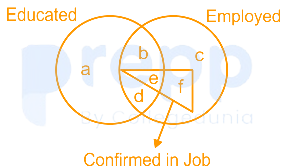
Read the given figure and find the region representing persons who are educated and employed but not confirmed in job.
The magazine in which Mahatma Gandhi mentioned what he wanted the Constitution to do is:
Which gas shields the surface of the earth from ultraviolet radiation from the sun?
Which event is marked as an Intangible Cultural Heritage of Humanity by UNESCO?
Who has been conferred with the rank of the Commander of the Order of the British Empire in 2018?


