
Pace of learning is
dependent on interaction of personal and environmental factors
The pace of learning is the speed at which a child acquires new knowledge and skills. Educational psychology treats learning as the outcome of continuous interaction between the learner and the surroundings, a view shared by Piaget, Vygotsky and Bronfenbrenner.
Personal factors such as maturation, health, intelligence, motivation, prior knowledge and interest set what a learner brings to a task. Environmental factors such as the home, teaching methods, peers, resources and the classroom climate shape the opportunities the learner gets. Neither set works alone: a motivated child in a poor environment and a well-resourced child with little interest may both learn slowly. The pace therefore depends on how these two sets of factors interact.
Saying that the pace depends solely on personal factors ignores the role of teaching and surroundings, and saying it depends solely on environmental factors ignores the learner's own readiness and motivation. Calling it independent of both makes no sense, because learning cannot happen apart from the learner and the context.
dependent on interaction of personal and environmental factors option is correct.
Similar Questions
The value of the expression \((-3)^3 \times (0.3)^{-2} \times 0.01\) lies between which of the following ranges?
In a class test, a student earns 3 marks for every correct answer and loses 2 marks for every incorrect answer. No marks are given for questions left unattempted. If Radhika scored 20 marks and had 12 correct answers, how many questions did she attempt incorrectly?
If a polyhedron has 6 faces and 12 edges, what is the number of its vertices?
If \(a\) and \(b\) are positive integers (where \(b \neq 0\)) such that \(a^b = 1331\), then what is the value of \((a+b)^{a-b-8}\)?
Numbers that can be expressed as the sum of two cubes in two different ways are known as:
If \(x + \dfrac{y}{2} = \dfrac{1}{4}\), \(y + \dfrac{z}{2} = \dfrac{1}{4}\) and \(z + \dfrac{x}{2} = \dfrac{1}{4}\), then what is the value of \(x + y + z\)?
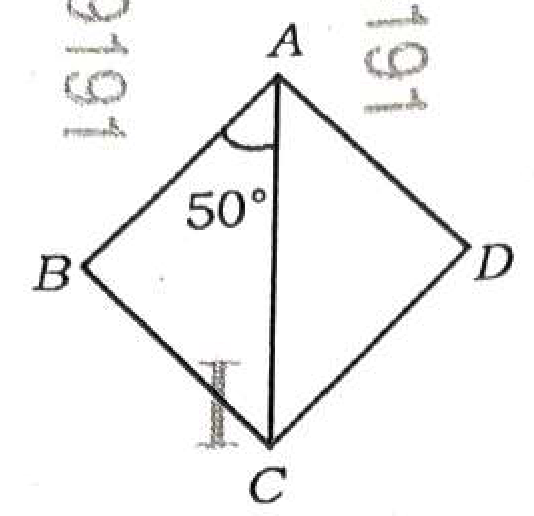
ABCD is a rhombus in which \(\angle BAC = 50^\circ\). What is the value of \(3\angle D - 2\angle DAC\)?
What is the value of \(\dfrac{\sqrt{450}}{\sqrt{338}} \div \dfrac{\sqrt{125}}{\sqrt{245}}\)?
The selling price of a toy is Rs. 1,020. If the profit made by the shopkeeper is 20%, what is the cost price of the toy?
The denominator of a rational number is greater than its numerator by 4. If 1 is added to both the numerator and the denominator, the resulting fraction is \(\dfrac{1}{2}\). Find the rational number.
Important Questions from Mixed Topic (JTET)
What type of process is thinking ?
The normal cause of origin of motivation is
How is impulse important for a teacher ?
The motive which forms due to social ideals, status, relations etc. is called
The learning in children starts from



