
Match the items of List I with the items of List II and choose the correct answer from the code given below. List – I List – II a Cycle stock i Hedge against the possibility of stockout b Transit stock ii Stock to meet inventory cycle c Buffer stock iii Stock moved between various elements of supply chain d Safety stock iv Extra stock to meet fluctuations in demand
Understanding Different Types of Inventory Stock
Inventory management is crucial for businesses. It involves knowing what types of stock are held and why. Let's look at some common types of inventory and their purposes, as listed in the question.
Matching Inventory Types with Definitions
We need to match each item from List I (types of stock) with its correct definition from List II.
Analyzing List I and List II Items:
- List I: a) Cycle stock, b) Transit stock, c) Buffer stock, d) Safety stock
- List II: i) Hedge against the possibility of stockout, ii) Stock to meet inventory cycle, iii) Stock moved between various elements of supply chain, iv) Extra stock to meet fluctuations in demand
Let's examine each type of stock:
- Cycle Stock: This is the portion of inventory available to meet normal demand during the period between the receipt of two replenishment orders. It's the inventory that is used up and replenished on a regular cycle. This matches with the definition "Stock to meet inventory cycle".
- Transit Stock: Also known as pipeline stock, this refers to inventory that is in transit from one location to another within the supply chain. It includes goods being shipped between warehouses, suppliers, or customers. This matches with the definition "Stock moved between various elements of supply chain".
- Buffer Stock: This term is often used interchangeably with safety stock, but it can also refer to inventory held to protect against production bottlenecks or irregularities in inflow/outflow. In the context of the given options, it relates to handling variability.
- Safety Stock: This is extra inventory held to mitigate risk of stockouts due to uncertainties in demand and lead time. It acts as a buffer against unexpected fluctuations. This directly aligns with the definition "Hedge against the possibility of stockout".
Now let's refine the matches based on the distinct definitions provided:
- (a) Cycle stock: The definition "Stock to meet inventory cycle" directly explains cycle stock. So, (a) matches (ii).
- (b) Transit stock: The definition "Stock moved between various elements of supply chain" clearly describes transit stock. So, (b) matches (iii).
- (d) Safety stock: The definition "Hedge against the possibility of stockout" is the primary purpose of safety stock. So, (d) matches (i).
- (c) Buffer stock: With (d) matching (i), the remaining definition "Extra stock to meet fluctuations in demand" is the best fit for buffer stock, as it serves to absorb variations beyond expected levels. So, (c) matches (iv).
Summary of Matching Inventory Types
Based on the analysis, the correct matches are:
| List I (Inventory Type) | List II (Definition) | Match |
|---|---|---|
| a) Cycle stock | ii) Stock to meet inventory cycle | a - ii |
| b) Transit stock | iii) Stock moved between various elements of supply chain | b - iii |
| c) Buffer stock | iv) Extra stock to meet fluctuations in demand | c - iv |
| d) Safety stock | i) Hedge against the possibility of stockout | d - i |
This gives us the matching sequence: (a) - (ii), (b) - (iii), (c) - (iv), (d) - (i).
Revision Table: Key Inventory Concepts
| Inventory Type | Purpose/Definition | Why it's Needed |
|---|---|---|
| Cycle Stock | Inventory to cover demand between orders | To meet regular demand in batches |
| Transit Stock | Inventory moving between locations | To account for transportation time in the supply chain |
| Buffer Stock | Extra stock for demand fluctuations/production issues | To handle unexpected variations or absorb shocks |
| Safety Stock | Extra stock to prevent stockouts | To protect against uncertainty in demand or lead time |
Additional Information on Inventory Management
Effective inventory management aims to balance the costs of holding inventory with the benefits of having stock available when needed. Different types of inventory serve specific purposes in achieving this balance within the supply chain. Understanding these types is fundamental to managing inventory efficiently, reducing costs, and improving customer service by avoiding stockouts.
- Stockout: A situation where demand for an item cannot be fulfilled from the current inventory.
- Supply Chain: The network of all the individuals, organizations, resources, activities, and technology involved in the creation and sale of a product, from the delivery of source materials from the supplier to the final delivery to the customer.
Important Questions from Miscellaneous
Read the given figure and find the region representing persons who are educated and employed but not confirmed in job.
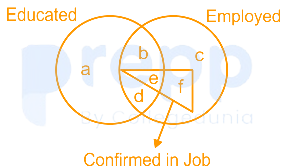
The magazine in which Mahatma Gandhi mentioned what he wanted the Constitution to do is:
Which gas shields the surface of the earth from ultraviolet radiation from the sun?
Which event is marked as an Intangible Cultural Heritage of Humanity by UNESCO?
Who has been conferred with the rank of the Commander of the Order of the British Empire in 2018?


