
Match List - I with List - II. List I (Types of Effect) List II (Description) A. I. B. II. C. III. D. IV.Veblen effect Conspicuous consumption Snob effect Reduction in relative price of commodity Bandwagon effect Negative network externality Substitution effect Positive network externality
Choose the correct answer from the options given below :
Understanding Economic Effects on Demand
Demand for a product is influenced by various factors, including its price, consumer income, prices of related goods, tastes, and expectations. However, there are other interesting effects that relate demand to social factors or price changes in specific ways. This question asks us to match some of these economic effects with their descriptions.
Matching Economic Effects with Descriptions
Let's analyze each economic effect listed in List I and find its corresponding description in List II.
| List I (Types of Effect) | List II (Description) |
|---|---|
| A. Veblen effect | I. Conspicuous consumption |
| B. Snob effect | II. Reduction in relative price of commodity |
| C. Bandwagon effect | III. Negative network externality |
| D. Substitution effect | IV. Positive network externality |
Analysis of Each Effect
A. Veblen Effect: Conspicuous Consumption
- The Veblen effect describes a situation where the demand for a good increases as its price increases, particularly among wealthy consumers. This happens because the high price makes the good a status symbol.
- Consumers buy these goods not just for their inherent value, but to display their wealth and social status.
- This behavior is known as conspicuous consumption. Therefore, the Veblen effect is directly related to conspicuous consumption.
- Match: A - I
B. Snob Effect: Negative Network Externality
- The Snob effect occurs when the demand for a good decreases as more people own it.
- Consumers exhibiting the snob effect value exclusivity and uniqueness. The appeal of the good diminishes if it becomes commonplace or widely owned.
- This is an example of a negative network externality, where the value or utility a user derives from a good decreases as more people use it.
- Match: B - III
C. Bandwagon Effect: Positive Network Externality
- The Bandwagon effect is the opposite of the snob effect. It occurs when the demand for a good increases because many other people are also consuming it.
- Consumers want to be "in style" or follow the crowd. The popularity of the good adds to its appeal.
- This is a positive network externality, where the value or utility a user derives from a good increases as more people use it. Think of social media platforms or fashionable items.
- Match: C - IV
D. Substitution Effect: Reduction in Relative Price
- The Substitution effect is a fundamental concept in consumer theory. It explains how a change in the price of a good, relative to the prices of other goods, impacts consumer demand.
- When the relative price of a commodity decreases, consumers tend to substitute away from relatively more expensive goods towards the now relatively cheaper commodity. This leads to an increase in the quantity demanded of the good whose relative price fell.
- A reduction in the relative price of a commodity is the direct trigger for the substitution effect to influence demand.
- Match: D - II
Summary of Matches
Based on the analysis, the correct matching is:
- A. Veblen effect → I. Conspicuous consumption
- B. Snob effect → III. Negative network externality
- C. Bandwagon effect → IV. Positive network externality
- D. Substitution effect → II. Reduction in relative price of commodity
| Effect | Match | Description |
|---|---|---|
| Veblen effect | I | Conspicuous consumption |
| Snob effect | III | Negative network externality |
| Bandwagon effect | IV | Positive network externality |
| Substitution effect | II | Reduction in relative price of commodity |
This corresponds to the option A - I, B - III, C - IV, D - II.
Revision Table: Key Economic Effects
| Effect | Nature | Relationship with Price/Others' Consumption |
|---|---|---|
| Veblen Effect | Status/Luxury | Demand increases as price increases (for status). |
| Snob Effect | Exclusivity | Demand decreases as others' consumption increases (negative network externality). |
| Bandwagon Effect | Popularity | Demand increases as others' consumption increases (positive network externality). |
| Substitution Effect | Relative Price Change | Demand for a good increases when its relative price falls (substituting away from others). |
Additional Information: Demand Theory Concepts
These economic effects are important concepts within microeconomics and consumer behavior theory.
- Network Externalities: These occur when the value of a product or service to a user depends on the number of other users. Positive externalities (like the bandwagon effect) make a good more valuable as it's more widely adopted. Negative externalities (like the snob effect) make a good less valuable as it's more widely adopted.
- Income Effect vs. Substitution Effect: When the price of a good changes, it affects demand through two channels: the substitution effect (change in relative prices, discussed above) and the income effect (change in purchasing power). The substitution effect always leads to buying more of a good when its price falls (assuming utility maximization).
- Giffen and Veblen Goods: While most goods follow the law of demand (quantity demanded falls as price rises), Giffen and Veblen goods are exceptions. Giffen goods are inferior goods where the income effect outweighs the substitution effect. Veblen goods are status symbols where the Veblen effect dominates.
Important Questions from Miscellaneous
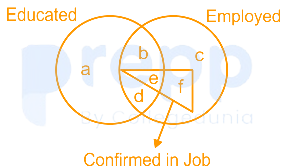
Read the given figure and find the region representing persons who are educated and employed but not confirmed in job.
The magazine in which Mahatma Gandhi mentioned what he wanted the Constitution to do is:
Which gas shields the surface of the earth from ultraviolet radiation from the sun?
Which event is marked as an Intangible Cultural Heritage of Humanity by UNESCO?
Who has been conferred with the rank of the Commander of the Order of the British Empire in 2018?


