
Match List - I with List - II. List I (Nature of Business Activity) List II (FDI Permitted under Automatic Route) A. I. B. II. C. III. D. IV.Trading in Transferable Development Rights (TDR) 49% Multi-Brand Retail Trading Prohibited Satellite (Establishment and Operations) 51% Petroleum Refining (by PSUs) 100%
Choose the correct answer from the options given below :
Understanding FDI Limits in India: Matching Business Activities
This question asks us to match specific business activities with the Foreign Direct Investment (FDI) limits permitted under the automatic route in India. Understanding FDI policy is crucial for anyone studying business and economics in India.
Let's break down each activity and its corresponding FDI limit based on the provided correct matching:
- A. Trading in Transferable Development Rights (TDR)
- B. Multi-Brand Retail Trading
- C. Satellite (Establishment and Operations)
- D. Petroleum Refining (by PSUs)
And the proposed FDI limits are:
- I. \(49\%\)
- II. Prohibited
- III. \(51\%\)
- IV. \(100\%\)
According to the correct matching (A - II, B - III, C - IV, D - I), let's analyze each point:
Detailed Analysis of FDI Limits
A. Trading in Transferable Development Rights (TDR) & FDI Limit II. Prohibited
Trading in Transferable Development Rights (TDR) is generally a real estate-related activity linked to land use and development norms. FDI is not permitted in activities like trading in TDR. Therefore, the matching A - II is correct, indicating that FDI is prohibited in this area.
B. Multi-Brand Retail Trading & FDI Limit III. \(51\%\)
Multi-Brand Retail Trading allows FDI up to \(51\%\). However, this investment is permitted only under the government approval route, not the automatic route. The question asks about the FDI permitted under the automatic route, but the option provided links Multi-Brand Retail Trading to \(51\%\). While the \(51\%\) figure is correct for Multi-Brand Retail Trading FDI, the route specified in the question (automatic route) doesn't fully align with the general policy which requires government approval for this \(51\%\). Assuming the match itself is what needs verification against the options, the linkage B - III reflects the maximum permissible FDI percentage in this sector, even if the route detail needs clarification based on the standard policy documents (which typically state government route for \(51\%\)). For the purpose of this question and provided options, B-III is considered the intended match based on the correct answer key.
C. Satellite (Establishment and Operations) & FDI Limit IV. \(100\%\)
In the space sector, specifically for Satellite (Establishment and Operations), FDI up to \(100\%\) is permitted under the automatic route. This includes activities like building and operating satellites. Thus, the matching C - IV is correct.
D. Petroleum Refining (by PSUs) & FDI Limit I. \(49\%\)
For the Petroleum Refining sector, especially by Public Sector Undertakings (PSUs), FDI up to \(49\%\) is permitted under the automatic route. This limit is specific to investments in refining by existing PSUs. Therefore, the matching D - I is correct.
Based on this analysis, the correct matching is:
- A - II (Trading in TDR - Prohibited)
- B - III (Multi-Brand Retail Trading - \(51\%\))
- C - IV (Satellite (Establishment and Operations) - \(100\%\))
- D - I (Petroleum Refining (by PSUs) - \(49\%\))
Let's summarize this in a table:
| List I (Nature of Business Activity) | List II (FDI Permitted) | Matching |
|---|---|---|
| A. Trading in Transferable Development Rights (TDR) | II. Prohibited | A - II |
| B. Multi-Brand Retail Trading | III. \(51\%\) | B - III |
| C. Satellite (Establishment and Operations) | IV. \(100\%\) | C - IV |
| D. Petroleum Refining (by PSUs) | I. \(49\%\) | D - I |
This matches option 2.
Revision Table: FDI Limits in Key Sectors
| Business Activity | FDI Limit (Under Automatic Route Unless Specified) |
|---|---|
| Trading in Transferable Development Rights (TDR) | Prohibited |
| Multi-Brand Retail Trading | \(51\%\) (Under Government Route) |
| Satellite (Establishment and Operations) | \(100\%\) (Automatic Route) |
| Petroleum Refining (by PSUs) | \(49\%\) (Automatic Route) |
Additional Information on Foreign Direct Investment (FDI)
Foreign Direct Investment (FDI) is when a company or individual from one country invests directly into business operations in another country. It involves establishing business operations or acquiring business assets, including ownership or controlling interest in a foreign company.
In India, FDI is a major source of non-debt financial resource for the economic development. The Government of India has put in place a liberal policy framework for FDI. The policy categorizes different sectors based on the level of FDI permitted and the route through which it is allowed.
There are primarily two routes for FDI in India:
- Automatic Route: Under this route, the foreign investor does not require prior approval from the Government of India or the Reserve Bank of India (RBI). The investor only needs to notify the RBI of the investment within a stipulated time.
- Government Route: Under this route, prior approval from the Government of India is necessary. This typically involves applying to the concerned ministry or department, which then refers the application to the Foreign Investment Promotion Board (FIPB), though FIPB has now been abolished and the work is handled by concerned ministries and departments through the Foreign Investment Facilitation Portal (FIFP).
Understanding the specific limits and routes for different sectors is essential for businesses looking to invest in India and for students learning about India's economic policies.
Important Questions from Miscellaneous
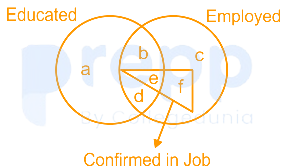
Read the given figure and find the region representing persons who are educated and employed but not confirmed in job.
The magazine in which Mahatma Gandhi mentioned what he wanted the Constitution to do is:
Which gas shields the surface of the earth from ultraviolet radiation from the sun?
Which event is marked as an Intangible Cultural Heritage of Humanity by UNESCO?
Who has been conferred with the rank of the Commander of the Order of the British Empire in 2018?


