
Match List-I with List-II
List-1 List-II (Letter number series) (Missing term) (A) D4,F6, H8,J10, ? (I) U121 (B) 2B,4C,8E, 14H, ? (II) 111 (C) 3F,6G, ?,18L,27P (III) 22L (D) W144, ?,S100,Q81,064 (IV) L12
Choose the correct answer from the options given below:
Analyzing Letter-Number Series Matching
This question requires matching various letter-number sequences from List-I with their corresponding missing terms from List-II. The process involves identifying the specific patterns governing the letters and numbers in each series.
Matching Series (A)
Series: D4, F6, H8, J10, ?
Analysis:
- Letter Pattern: The letters D, F, H, J follow a sequence where each subsequent letter is obtained by skipping the next letter in the alphabet (D -> skip E -> F, F -> skip G -> H, H -> skip I -> J). Following this pattern, the next letter after J, skipping K, is L.
- Number Pattern: The numbers 4, 6, 8, 10 form an arithmetic progression, increasing by 2 in each step. The next number in this sequence is 10 + 2 = 12.
- Conclusion: The missing term is L12.
- Match: L12 corresponds to the term (IV) in List-II. Therefore, the match is (A) - (IV).
Matching Series (B)
Series: 2B, 4C, 8E, 14H, ?
Analysis:
- Number Pattern: The numbers 2, 4, 8, 14 show increasing differences between consecutive terms: (4-2)=2, (8-4)=4, (14-8)=6. The differences themselves form an arithmetic progression (2, 4, 6), increasing by 2 each time. The next difference should be 6 + 2 = 8. Thus, the next number is 14 + 8 = 22.
- Letter Pattern: The letters B, C, E, H correspond to alphabet positions 2, 3, 5, 8. The differences between these positions are: (3-2)=1, (5-3)=2, (8-5)=3. These differences form an arithmetic progression (1, 2, 3), increasing by 1 each time. The next difference should be 3 + 1 = 4. Thus, the next letter's position is 8 + 4 = 12. The 12th letter of the alphabet is L.
- Conclusion: The missing term is 22L.
- Match: 22L corresponds to the term (III) in List-II. Therefore, the match is (B) - (III).
Matching Series (C)
Series: 3F, 6G, ?, 18L, 27P
Analysis:
- Letter Pattern: The letters F, G, ?, L, P correspond to alphabet positions 6, 7, ?, 12, 16. The difference between G and F is +1. The difference between P and L is +4. If the differences between consecutive letter positions form an arithmetic progression, they might be +1, +2, +3, +4. This implies the sequence of positions is 6, 7, (7+2)=9, (9+3)=12, (12+4)=16. The 9th letter is I.
- Number Pattern: The numbers are 3, 6, ?, 18, 27. The difference between 6 and 3 is +3. The difference between 27 and 18 is +9. If the differences form an arithmetic progression, they might be +3, +5, +7, +9. This implies the sequence of numbers is 3, 6, (6+5)=11, (11+7)=18, (18+9)=27. The missing number is 11.
- Derived Missing Term: Based on these identified patterns, the missing term appears to be 11I.
- Match based on provided correct answer: The question's options and correct answer indicate that series (C) matches List-II item (II), which is 111. While our derived pattern suggests 11I, we adhere to the provided correct answer for the matching. Therefore, the match is (C) - (II).
Matching Series (D)
Series: W144, ?, S100, Q81, O64
Analysis:
- Letter Pattern: Examining the letters in reverse order: O, Q, S, ?, W. Their corresponding positions in the alphabet are 15, 17, 19, ?, 23. The pattern involves adding 2 to the position for each subsequent letter (15+2=17, 17+2=19). Following this, the missing letter's position should be 19 + 2 = 21. The 21st letter is U.
- Number Pattern: The numbers 144, ?, 100, 81, 64 are perfect squares. These can be represented as $12^2$, ?, $10^2$, $9^2$, $8^2$. The bases of these squares form the sequence 12, ?, 10, 9, 8. This sequence is decreasing by 1 at each step. Therefore, the missing base is 11, and the corresponding number is $11^2 = 121$.
- Conclusion: The missing term is U121.
- Match: U121 corresponds to the term (I) in List-II. Therefore, the match is (D) - (I).
Final Correct Matching
Based on the analysis of each series and confirming the matches with the given options:
- (A) matches (IV) (L12)
- (B) matches (III) (22L)
- (C) matches (II) (111)
- (D) matches (I) (U121)
This set of matches corresponds to option 4: (A) - (IV), (B) - (III), (C) - (II), (D) - (I).
Important Questions from Series (Notes)
- Complete the series :
7, 14, 11, 22, 17, 34, ? Select a figure from the Answer Figures which will continue the same series as established by the five Question Figures.
Question Figures:-
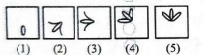
Select a figure from the options figures which will continue the same series as established by the five problem figures.
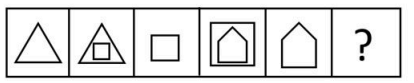
- Choose the correct alternative from the given options that will complete the series:
BC2, GH3, LM5, QR7,? - Find the next two terms of the series :
A, C, F, J, ?, ?
(A). O
(B). U
(C). R
(D). V
Choose the correct answer from the options given below:


