
Let r and $ \theta $ be the polar coordinates defined by $x = r \cos \theta$ and $y = r \sin \theta$. The area of the cardioid $r = a (1 - \cos \theta)$, $0 \le \theta \le 2\pi$, is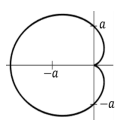
The given problem asks for the area of the cardioid described by the polar equation \( r = a (1 - \cos \theta) \) over the interval \( 0 \leq \theta \leq 2\pi \).
To find the area enclosed by the cardioid, we can use the formula for the area \( A \) in polar coordinates:
\(A = \frac{1}{2} \int_{\theta_1}^{\theta_2} r^2 \, d\theta\)
Substituting \( r = a(1 - \cos \theta) \) into the equation, we need to calculate:
\(A = \frac{1}{2} \int_{0}^{2\pi} [a(1 - \cos \theta)]^2 \, d\theta\)
Expand \( [a(1 - \cos \theta)]^2 \):
\(= a^2 (1 - 2\cos \theta + \cos^2 \theta)\)
Use the identity \( \cos^2 \theta = \frac{1 + \cos 2\theta}{2} \):
\(= a^2 \left(1 - 2\cos \theta + \frac{1 + \cos 2\theta}{2}\right)\) \(= a^2 \left(\frac{3}{2} - 2\cos \theta + \frac{\cos 2\theta}{2}\right)\)
Now plug this back into the integral:
\(A = \frac{a^2}{2} \int_{0}^{2\pi} \left(\frac{3}{2} - 2\cos \theta + \frac{\cos 2\theta}{2}\right) \, d\theta\)
Integrate term by term:
- \(\int_{0}^{2\pi} \frac{3}{2} \, d\theta = \frac{3}{2}[2\pi - 0] = 3\pi\)
- \(\int_{0}^{2\pi} -2\cos \theta \, d\theta = 0\) (as the integral of cosine over a full period is zero)
- \(\int_{0}^{2\pi} \frac{\cos 2\theta}{2} \, d\theta = 0\) (for the same reason as cosine)
Combining these results:
\(A = \frac{a^2}{2} \cdot 3\pi = \frac{3\pi a^2}{2}\)
Thus, the area of the cardioid is \(\frac{3\pi a^2}{2}\).
This is the correct answer.
Important Questions from Application Of Definite Integral (Area)
- The area in the first quadrant bounded by the function $y = (8 - x)$ and the coordinate axes is ______ square units (answer in integer).
- Consider the following curve in polar coordinates.
$$ r = 2 - 2 \sin \theta $$
Which one of the following is the area enclosed by the curve for $0 \leq \theta \leq 2\pi$ ? Consider the equation for a curve, $y = f(x) = x^2 + x$.
The area enclosed by the curve, the x -axis ($y = 0$ line); the vertical lines passing through $x = 1$ and $x = 2$ is _________ (rounded off to 2 decimal places)The area bounded by the curves, $y = \sqrt{x}$, and $y = 8x^2$ is _______________(rounded off to 3 decimal places)
- The area of the region (rounded off to one decimal place) enclosed between the curves $y = x$ and $y = 3\sqrt{x}$ and between the lines $x = 0$ and $x = 1$ is ________ units.


