
Let $G(s) = \frac{1}{(s+1)(s+2)}$. Then the closed-loop system shown in the figure below, is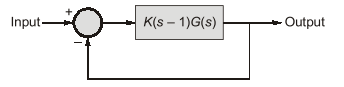
To determine the stability of the closed-loop system, we need to analyze the characteristic equation. Given the open-loop transfer function:
\(G(s) = \frac{1}{(s+1)(s+2)}\)
The transfer function of the feedback system with unity feedback is:
\(T(s) = \frac{K \cdot G(s)}{1 + K \cdot G(s)}\)
Substituting \(G(s)\):
\(T(s) = \frac{K}{(s+1)(s+2) + K}\)
The characteristic equation can be derived from:
\(1 + K \cdot G(s) = 0\)
Therefore:
\((s+1)(s+2) + K = 0\)
Expanding this, we get:
\(s^2 + 3s + 2 + K = 0\)
This simplifies to:
\(s^2 + 3s + (2 + K) = 0\)
By applying the Routh-Hurwitz criterion, for the system to be stable, all the coefficients of the Routh array must be positive. The first two rows of the Routh array are:
- First row: \(1\), \(3\)
- Second row: \(2 + K\)
For the second row to be positive:
\(2 + K > 0\)
This implies:
\(K > -2\)
However, for the system to maintain closed-loop stability, \(K\) must also ensure all the elements of the Routh array remain positive. The critical factor for stability is typically the determinant of the first column:
\(2 + K > 3 \cdot 0\)
The system becomes unstable if:
\(K > 2\)
Hence, the closed-loop system is unstable for all \(K > 2\).
Therefore, the correct answer is:
- Unstable for all \(K > 2\).
Important Questions from Stability Analysis
For a stable system, poles of the transfer function
If a system has simple poles lying on the imaginary axis and no poles to its right, it is
The number of sign changes in the first column of the Routh's array denotes:
The closed loop transfer function of a system is \(T\left( s \right) = \frac{{\left( {s + 8} \right)\left( {s + 6} \right)}}{{{s^5} - {s^4} + 4{s^3} - 4{s^2} + 3s - 2}}\). The function of poles in RHP and LHP are
The margin between actual gain and critical gain is a measure of


