
Let $G(s) = \frac{1}{10s^2}$ be the transfer function of a second-order system. A controller $M(s)$ is connected to the system $G(s)$ in the configuration shown below. Consider the following statements.
(i) There exists no controller of the form $M(s) = \frac{K_I}{s}$, where $K_I$ is a positive real number, such that the closed loop system is stable.
(ii) There exists at least one controller of the form $M(s) = K_P + sK_D$, where $K_P$ and $K_D$ are positive real numbers, such that the closed loop system is stable.
Which one of the following options is correct?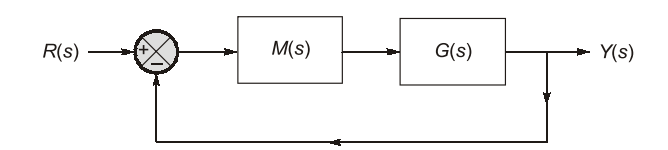
To determine the correctness of the statements, we need to analyze the stability of the closed-loop system with different controllers. The system configuration is shown in the figure above.
Let's denote the transfer function of the system as \(G(s) = \frac{1}{10s^2}\). The open-loop transfer function with controller \(M(s)\) is given by:
\(L(s) = M(s)G(s)\)
For the system to be stable, the closed-loop characteristic equation \(1 + L(s) = 0\) must have poles with negative real parts.
Analysis of Statement (i):
Statement (i) asserts that there is no controller of the form \(M(s) = \frac{K_I}{s}\) (Integral controller) such that the closed-loop system is stable.
Substitute \(M(s) = \frac{K_I}{s}\) into the open-loop transfer function:
\(L(s) = \frac{K_I}{s} \cdot \frac{1}{10s^2} = \frac{K_I}{10s^3}\)
The characteristic equation becomes:
\(1 + \frac{K_I}{10s^3} = 0\)
This simplifies to:
\(10s^3 + K_I = 0\)
The roots of this characteristic equation are \(s = -\sqrt[3]{\frac{K_I}{10}}\). All roots are on the real axis, but one root will be positive, causing instability for \(K_I > 0\). Thus, statement (i) is TRUE.
Analysis of Statement (ii):
Statement (ii) claims there is at least one controller of the form \(M(s) = K_P + sK_D\) (Proportional-Derivative controller) which makes the system stable.
Substitute \(M(s) = K_P + sK_D\) into the open-loop transfer function:
\(L(s) = (K_P + sK_D) \cdot \frac{1}{10s^2} = \frac{K_P}{10s^2} + \frac{K_D}{10s}\)
The characteristic equation is:
\(10s^2 + K_Ds + K_P = 0\)
This is a standard second-order polynomial. For stability, the roots must have negative real parts. This occurs if the coefficients meet the Routh-Hurwitz criterion. Specifically, both \(K_D > 0\) and \(K_P > 0\) are necessary for stability.
By choosing appropriate positive values for \(K_P\) and \(K_D\), stability can be achieved, making statement (ii) TRUE.
Therefore, the correct option is: Both (i) and (ii) are TRUE.
Important Questions from Controllers
What effect does the proportional parameter of control response have on the rise time in a closed-loop control system?
Which control method is best suitable to eliminate steady state error in closed loop response?
Which of the following is considered as a controller in an automatic toaster system ?
In a feedback control system, the derivative (D) controller has an output proportional to:
A condition where integral control drives the output of a controller into saturation is called ______


