
$d_1(u, v) \leq d_2(u, v)$
Understanding the Problem: Shortest Paths in Graphs and MSTs
We are given an undirected graph, let's call it G, where all edges have positive weights.
A Minimum Spanning Tree (MST), denoted as T, is a special selection of edges from G that connects all the vertices together, forming a tree structure (no cycles), and having the minimum possible total edge weight among all such connecting trees.
We need to compare two types of distances between any two vertices, say u and v:
- $d_1(u, v)$: The shortest path distance between u and v in the original graph G. This path can use any edge from G.
- $d_2(u, v)$: The shortest path distance between u and v specifically within the Minimum Spanning Tree T. Since T is a tree, there's only one unique simple path between any two vertices in T.
The question asks for the correct relationship between $d_1(u, v)$ and $d_2(u, v)$ that holds true for any graph G, its MST T, and any pair of vertices u and v.
Analyzing the Paths
Consider the unique path between vertices u and v within the Minimum Spanning Tree T. Let the sum of the weights of the edges along this path be $W_T(u, v)$. By definition, $d_2(u, v) = W_T(u, v)$.
Now, think about the original graph G. This path existing in T is also a valid path between u and v in the larger graph G, because all edges in T are also edges in G.
The shortest distance $d_1(u, v)$ in G is defined as the minimum distance among *all* possible paths between u and v in G.
Since the path in T (with distance $d_2(u, v)$) is just one of the many possible paths in G, the shortest path in G ($d_1(u, v)$) cannot be longer than this path. It must be either shorter or equal in length.
Therefore, we can conclude that $d_1(u, v) \leq d_2(u, v)$.
Illustrative Example
Imagine a graph with 4 vertices: A, B, C, D. Edges and weights:
- (A, B) with weight 1
- (B, C) with weight 1
- (C, D) with weight 1
- (A, D) with weight 4
An MST (T) could consist of the edges {(A, B), (B, C), (C, D)}. The total weight is 3.
Let's find the distances between A and D:
- In T: The unique path is A -> B -> C -> D. The distance $d_2(A, D)$ is $1 + 1 + 1 = 3$.
- In G: The paths are A -> B -> C -> D (distance 3) and the direct edge A -> D (distance 4). The shortest path is A -> B -> C -> D. So, $d_1(A, D) = 3$. In this case, $d_1(A, D) = d_2(A, D)$.
Now, consider another edge:
- (A, C) with weight 1.5
Graph edges: (A, B, 1), (B, C, 1), (C, D, 1), (A, D, 4), (A, C, 1.5). A possible MST (T) could be {(A, B, 1), (A, C, 1.5), (C, D, 1)}. Total weight = 3.5.
Distances between A and D:
- In T: The unique path is A -> C -> D. The distance $d_2(A, D)$ is $1.5 + 1 = 2.5$.
- In G: Paths include:
- A -> C -> D (distance 2.5)
- A -> B -> C -> D (distance 1 + 1 + 1 = 3)
- A -> D (distance 4)
Consider one more edge:
- (A, D) with weight 2
Graph edges: (A, B, 1), (B, C, 1), (C, D, 1), (A, D, 2). An MST (T) could be {(A, B, 1), (B, C, 1), (C, D, 1)}. Total weight = 3.
Distances between A and D:
- In T: The unique path is A -> B -> C -> D. The distance $d_2(A, D)$ is $1 + 1 + 1 = 3$.
- In G: Paths include:
- A -> B -> C -> D (distance 3)
- A -> D (distance 2)
These examples show that the shortest distance in the original graph G ($d_1$) can be less than or equal to the distance in the MST ($d_2$).
Conclusion
The path between u and v in the MST T is just one possible path in the original graph G. The shortest path distance $d_1(u, v)$ in G considers all paths, including potentially shorter ones than the path in T. Therefore, the shortest distance in G must be less than or equal to the distance of the path in T.
The correct relationship is: $ d_1(u, v) \leq d_2(u, v) $
Important Questions from Spanning Tree
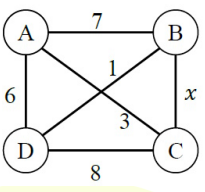
The maximum value of 𝑥 such that the edge between the nodes B and C is included in every minimum spanning tree of the given graph is _________ . (answer in integer)
Given below are two statements: one is labelled as Assertion A and the other is labelled as Reason R
Assertion A: Kruskal's algorithm and Prim's algorithm always produce minimum spanning tree (MST).
Reason R: Every connected graph has a unique MST.
In the light of the above statements, choose the most appropriate answer from the options given below


