
Leadership is ______
The function of influencing a group towards the achievement of goals
Leadership Definition: Influencing Groups Towards Goals
Leadership is a fundamental concept in management and organizational behavior. It centers on guiding and motivating people. Understanding its core definition helps clarify the role of a leader.
Understanding Leadership as a Function
The provided definition, "The function of influencing a group towards the achievement of goals," accurately captures the essence of leadership.
Let's break down why this definition is effective:
- Function: This term emphasizes that leadership is an active role or task performed by an individual or individuals within a group. It's something leaders *do*.
- Influencing: This is the core mechanism of leadership. Leaders persuade, motivate, and guide others, rather than relying solely on authority or command.
- Group: Leadership operates within a social context. It involves interaction with and impact on a collection of people working together.
- Achievement of Goals: The ultimate purpose of leadership is to direct the group's efforts towards accomplishing specific, shared objectives.
Comparing Leadership Concepts
The other options represent related ideas but are not as precise as the chosen definition:
| Option Text | Analysis |
| The process of influencing a group towards the achievement of goals | This highlights the dynamic nature of leadership (a process), which is valid, but "function" more directly describes the leader's role. |
| A group that achieves goals | This describes the result or characteristics of a successful group, not the act of leadership itself. |
| The function of influencing a group towards the achievement of goals | This is the most complete definition, identifying leadership as a specific function focused on influence, targeting a group, and aiming for goal achievement. |
| Directing a group towards the achievement of goals | Directing is a key part of leadership, but it might understate the importance of inspiration, motivation, and broader influence which are central to the concept. |
Therefore, leadership is best understood as the specific function of applying influence to guide a group effectively toward the achievement of its goals.
Important Questions from Miscellaneous
Read the given figure and find the region representing persons who are educated and employed but not confirmed in job.
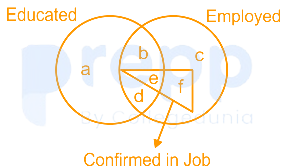
The magazine in which Mahatma Gandhi mentioned what he wanted the Constitution to do is:
Which gas shields the surface of the earth from ultraviolet radiation from the sun?
Which event is marked as an Intangible Cultural Heritage of Humanity by UNESCO?
Who has been conferred with the rank of the Commander of the Order of the British Empire in 2018?


