
Read the following Passage and answer the following questions. One of the main tenets of the plate tectonics theory is that plates move as somewhat rigid units relative to all other plates. As plates move, the distance between two locations on different plates gradually changes. Major interactions of plates occur along their boundaries. They make three types of boundaries- convergent plate boundaries; divergent plate boundaries and transform plate boundaries. The continental drift theory, conventional currents concept and sea floor spreading concept provided the base for the theory of plate tectonics. It explains formation of first and second order landforms. It explains several other phenomena such as mountain building, sea floor trench formation, volcanism, and seismicity.
_______ is NOT an evidence in support of sea floor spreading.
Tidal force
Understanding Evidence for Seafloor Spreading
The theory of plate tectonics, which built upon concepts like continental drift and seafloor spreading, explains how large segments of Earth's lithosphere move. Seafloor spreading is a fundamental process where new oceanic crust is formed through volcanic activity and then gradually moves away from a mid-ocean ridge. Scientists have gathered various types of evidence to support this process. The question asks us to identify which option is NOT considered evidence in support of seafloor spreading.
Analyzing the Options for Seafloor Spreading Evidence
Let's examine each option provided and see how it relates to the concept of seafloor spreading:
- Age of sediments: Studies of sediment layers on the ocean floor show that the sediments are thinnest near mid-ocean ridges and become progressively thicker with increasing distance from the ridges. Furthermore, the age of the oldest sediment layer directly above the oceanic crust increases as you move away from the ridge. This pattern strongly supports the idea that new crust is continuously being formed at the ridge and moving outward, accumulating sediments over time.
- Paleomagnetism: Rocks formed at mid-ocean ridges contain magnetic minerals that align with the Earth's magnetic field at the time of their formation. As new crust is created and moves away, it records the history of Earth's magnetic field reversals in symmetrical bands parallel to the ridge. This pattern of magnetic stripes, or paleomagnetic anomalies, found on either side of mid-ocean ridges, is considered one of the most compelling pieces of evidence for seafloor spreading. It provides a clear record of the creation and movement of new oceanic crust over millions of years.
- Tidal force: Tidal forces are the gravitational forces exerted by the Moon and the Sun on the Earth. These forces primarily cause the rise and fall of ocean tides and slight deformations of the solid Earth. While tidal forces are a significant geological phenomenon, they are not considered evidence for the process of seafloor spreading itself. They are unrelated to the mechanism by which new oceanic crust is generated at mid-ocean ridges or the movement of tectonic plates driven by forces within the Earth, such as mantle convection.
- Mapping of volcanic islands and seamounts: Mid-ocean ridges themselves are vast underwater volcanic mountain ranges where seafloor spreading occurs. Mapping these features shows the global extent of this active volcanic process. While volcanic islands and seamounts can form in various tectonic settings, mapping the active volcanic areas specifically along the mid-ocean ridge system provides evidence of the location where new crust is being added to the seafloor through volcanic activity associated with spreading.
Conclusion on Evidence for Seafloor Spreading
Based on the analysis, the age of sediments, paleomagnetic stripes, and the mapping of volcanic activity along mid-ocean ridges are all forms of evidence that support the theory of seafloor spreading. Tidal force, however, is a phenomenon caused by gravitational interactions with celestial bodies and is not used as evidence to support or explain the mechanism of seafloor spreading.
Therefore, tidal force is NOT an evidence in support of seafloor spreading.
Revision Table: Seafloor Spreading Evidence
| Evidence Type | How it Supports Seafloor Spreading |
|---|---|
| Age of Sediments & Crust | Oceanic crust and overlying sediments are youngest/thinnest near mid-ocean ridges and progressively older/thicker further away. |
| Paleomagnetism | Symmetrical magnetic stripes (recording Earth's magnetic reversals) are found on either side of mid-ocean ridges. |
| Mapping of Volcanic Features (Mid-Ocean Ridges) | Identifies the location of extensive volcanic activity where new crust is formed. |
| Heat Flow | Higher heat flow observed near mid-ocean ridges compared to older seafloor. |
| Earthquakes | Shallow earthquakes concentrated along the mid-ocean ridge axis. |
Additional Information: Seafloor Spreading and Plate Tectonics
Seafloor spreading is a key component of the larger theory of plate tectonics. It primarily occurs at divergent plate boundaries, where tectonic plates move away from each other. The gap created is filled by magma rising from the mantle, which cools and solidifies to form new oceanic crust. This process is thought to be driven by convection currents in the Earth's mantle. As new crust is added at divergent boundaries, older crust is typically consumed at convergent plate boundaries through subduction zones.
Understanding seafloor spreading helps explain:
- The relatively young age of oceanic crust compared to continental crust.
- The distribution of earthquakes and volcanoes around the globe.
- The formation of major geological features like mid-ocean ridges and deep-sea trenches.
Important Questions from Miscellaneous
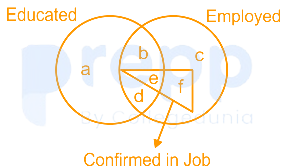
Read the given figure and find the region representing persons who are educated and employed but not confirmed in job.
The magazine in which Mahatma Gandhi mentioned what he wanted the Constitution to do is:
Which gas shields the surface of the earth from ultraviolet radiation from the sun?
Which event is marked as an Intangible Cultural Heritage of Humanity by UNESCO?
Who has been conferred with the rank of the Commander of the Order of the British Empire in 2018?


