
In the Wheatstone bridge shown below, the sensitivity of the bridge in terms of change in balancing voltage $E$ for unit change in the resistance $R$, in mV/$\Omega$, is _______. (round off to two decimal places)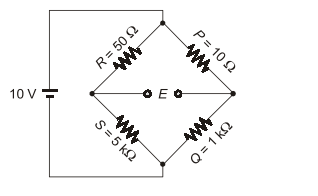
The sensitivity of the Wheatstone bridge is defined as the change in the output (balancing) voltage $E$ per unit change in the measured resistance $R$ (i.e., $\frac{dE}{dR}$).
1. Define Parameters and Output Voltage
The bridge output voltage $E$ is the potential difference between the midpoints of the two arms, assuming the meter is disconnected (open circuit voltage $V_{oc}$).
Let $V_L$ be the voltage at the left midpoint (between $R$ and $S$), and $V_R$ be the voltage at the right midpoint (between $P$ and $Q$). $E = V_L - V_R$.
The source voltage is $V = 10 \text{ V}$. The bottom rail is the reference (ground).
- $R = 50 \ \Omega$
- $S = 5 \text{ k}\Omega = 5000 \ \Omega$
- $P = 10 \ \Omega$
- $Q = 1 \text{ k}\Omega = 1000 \ \Omega$
The output voltage $E$ is:
$$E = V \left( \frac{S}{R + S} - \frac{Q}{P + Q} \right)$$
In this problem, $R$ is the variable resistor, and the sensitivity is calculated with respect to $R$.
$$E = V \left[ \frac{S}{R + S} - \frac{Q}{P + Q} \right]$$
2. Calculate the Sensitivity ($\frac{dE}{dR}$)
Since only $R$ is the variable, the term $\frac{Q}{P + Q}$ is a constant. We differentiate $E$ with respect to $R$:
$$\frac{dE}{dR} = \frac{d}{dR} \left( V \frac{S}{R + S} \right) - \frac{d}{dR} \left( V \frac{Q}{P + Q} \right)$$
The second term is zero. We use the chain rule on the first term:
$$\frac{d}{dR} \left( \frac{S}{R + S} \right) = S \cdot (-1) (R + S)^{-2} \cdot 1 = - \frac{S}{(R + S)^2}$$
$$\frac{dE}{dR} = - V \frac{S}{(R + S)^2}$$
3. Substitute Numerical Values
The initial state values are used for calculation:
- $V = 10 \text{ V}$
- $R = 50 \ \Omega$
- $S = 5000 \ \Omega$
$$\frac{dE}{dR} = - 10 \text{ V} \cdot \frac{5000 \ \Omega}{(50 \ \Omega + 5000 \ \Omega)^2}$$ $$\frac{dE}{dR} = - 10 \cdot \frac{5000}{(5050)^2}$$ $$\frac{dE}{dR} = - \frac{50000}{25,502,500}$$ $$\frac{dE}{dR} \approx -0.0019606 \text{ V}/\Omega$$
The question asks for the sensitivity in terms of magnitude ($\text{mV}/\Omega$).
$$\left| \frac{dE}{dR} \right| = 0.0019606 \text{ V}/\Omega$$
Convert to $\text{mV}/\Omega$ ($1 \text{ V} = 1000 \text{ mV}$):
$$\text{Sensitivity} = 0.0019606 \times 1000 \text{ mV}/\Omega \approx 1.9606 \text{ mV}/\Omega$$
4. Final Formatting
Rounding off to two decimal places:
$$\text{Sensitivity} = 1.96 \text{ mV}/\Omega$$
This result falls within the constraint range [1.94, 2].
The sensitivity of the bridge is 1.96 $\text{mV}/\Omega$.
Important Questions from Measurement of R/L/C Using Bridge Circuits
Megger is a measuring instrument, used for the measurement of:
Which of the following bridges is used to measure dielectric loss and capacitance of dielectric material?
In which of the following, vibration galvanometer, tuneable amplifier and headphones are used?
How much accuracy can be obtained using Wien’s bridge?
Maxwell bridge is used to measure


