
In the RLC circuit shown in the figure, the input voltage is given by $v_i(t) = 2 \cos(200t) + 4 \sin(500t)$. The output voltage $v_o(t)$ is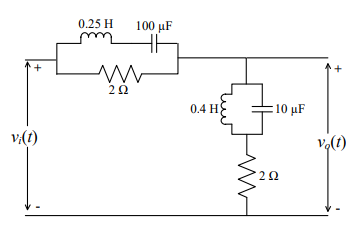
To solve this problem, we need to analyze the given RLC circuit and determine how the input voltage \(v_i(t)\) affects the output voltage \(v_o(t)\). Let's break it down step-by-step:
Step 1: Understanding the Circuit
The circuit is composed of inductors, capacitors, and resistors. The input voltage \(v_i(t) = 2 \cos(200t) + 4 \sin(500t)\) is applied across this network. We need to find how this affects \(v_o(t)\).
Step 2: Analyzing Frequency Components
The input signal has two frequency components:
- \(2 \cos(200t)\) with an angular frequency \(\omega_1 = 200 \, \text{rad/s}\)
- \(4 \sin(500t)\) with an angular frequency \(\omega_2 = 500 \, \text{rad/s}\)
Step 3: Filter Analysis
The network likely acts as a filter. We need to determine if it is a low-pass, high-pass, band-pass, or band-stop filter to decide how each frequency component is affected.
- The component values (inductor and capacitor) indicate it may act as a filter with specific cutoff filters based on resonance.
- Check if the components resonate at either of these frequencies. By analyzing the component values, it can resonate at these specific frequencies based on the condition of \(\omega = \frac{1}{\sqrt{LC}}\).
Step 4: Resonance and Pass Band
To determine resonance conditions:
- \(L_1 = 0.25 \, \text{H}\) and \(C_1 = 100 \, \mu\text{F}\) give a resonant frequency \(\omega = \frac{1}{\sqrt{0.25 \times 100 \times 10^{-6}}} \approx 200 \, \text{rad/s}\)
- \(L_2 = 0.4 \, \text{H}\) and \(C_2 = 10 \, \mu\text{F}\) give a resonant frequency \(\omega = \frac{1}{\sqrt{0.4 \times 10 \times 10^{-6}}} \approx 500 \, \text{rad/s}\)
Both components are at the resonant frequencies of the input components, making the circuit pass both frequencies.
Step 5: Conclusion
Since both frequency components coincide with the resonance frequencies of the circuit components, the output voltage is unaffected and will appear as the input voltage.
The output voltage \(v_o(t)\) is therefore:
\(v_o(t) = 2\cos(200t) + 4 \sin(500t)\)
Correct Answer: \(2\cos(200t) + 4 \sin(500t)\)
Important Questions from Sinusoidal Steady State Analysis
The total opposition offered to the flow of current in AC circuit is called-
A quantity whose magnitude has a definite repeating time cycle is called a-
The current drawn by a tungsten filament lamp is measured by an ammeter. The ammeter reading under steady state condition will be ______ the ammeter reading when the supply is switched on.
The current flowing through a pure inductor in an AC circuit lags the applied voltage by:
What is the average value of a sine wave Vm sinωt over a full cycle?


