
McCabe-Thiele Feed Quality Analysis
This question relates the position of the intersection point between the q-line and the vapor-liquid equilibrium (VLE) curve on a McCabe-Thiele diagram to the condition of the feed stream.
Understanding the q-line Intersection
In the McCabe-Thiele method for distillation column design:
- The VLE curve represents the equilibrium relationship between the mole fraction of the more volatile component in the liquid phase ($x$) and the vapor phase ($y$). Let this be described by the function $y = f(x)$.
- The q-line represents the feed condition. It passes through the point $(x_f, x_f)$ on the $y=x$ diagonal, where $x_f$ is the mole fraction of the feed.
- The intersection point $(x_{int}, y_{int})$ is where the q-line meets the VLE curve.
- The question states a specific condition: the x-coordinate of the intersection point is greater than the x-coordinate of the feed point, i.e., $x_{int} > x_f$.
Relating Intersection to Feed Quality (q value)
The relationship between the compositions on the q-line and the feed can be mathematically expressed. For the intersection point $(x_{int}, y_{int})$ on the VLE curve ($y_{int} = f(x_{int})$), the condition derived from the q-line properties is:
$f(x_{int}) - x_{int} = \frac{x_{int}-x_f}{q-1}$Where '$q$' is the fraction of the feed stream that is in the liquid phase.
Analyzing the Condition $x_{int} > x_f$
We analyze the equation based on the value of $q$, assuming a typical VLE curve where $f(x) > x$ for $x < 1$ (thus $f(x_{int}) - x_{int} > 0$):
- If $q > 1$ (Liquid feed): Then $q-1 > 0$. For the equation $\frac{x_{int}-x_f}{q-1} > 0$ to hold, we must have $x_{int}-x_f > 0$, which means $x_{int} > x_f$. This matches the question's condition. A feed with $q>1$ is liquid below its bubble point.
- If $0 < q < 1$ (Mixed feed): Then $q-1 < 0$. For $\frac{x_{int}-x_f}{q-1} > 0$ to hold, we must have $x_{int}-x_f < 0$, meaning $x_{int} < x_f$. This contradicts the condition.
- If $q = 1$ (Saturated liquid feed): The q-line is a vertical line $x = x_f$. Thus, $x_{int} = x_f$. This contradicts the condition $x_{int} > x_f$.
- If $q = 0$ (Saturated vapor feed): The q-line is a horizontal line $y = x_f$. The intersection is $(x_{int}, x_f)$, so $f(x_{int}) = x_f$. Since $f(x_{int}) > x_{int}$ (for $x_{int}<1$), it follows that $x_f > x_{int}$. This contradicts the condition.
- If $q < 0$ (Superheated vapor feed): Then $q-1 < 0$. For $\frac{x_{int}-x_f}{q-1} > 0$ to hold, we must have $x_{int}-x_f < 0$, meaning $x_{int} < x_f$. This contradicts the condition.
Conclusion
The condition where the x-coordinate of the intersection point $(x_{int})$ is greater than the feed point x-coordinate $(x_f)$ occurs only when $q > 1$. This corresponds to a feed that is liquid below its bubble point.
Important Questions from Distillation
A binary mixture of butane and butadiene is to be separated in an extractive distillation using furfural. Furfural lowers the activity of butadiene more than it does for butane. Consider the distillation sequence shown in the figure.
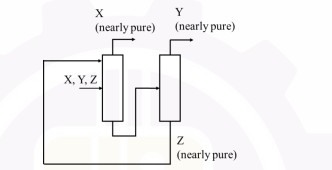
Match the component labels in Group I with chemical species in Group II.
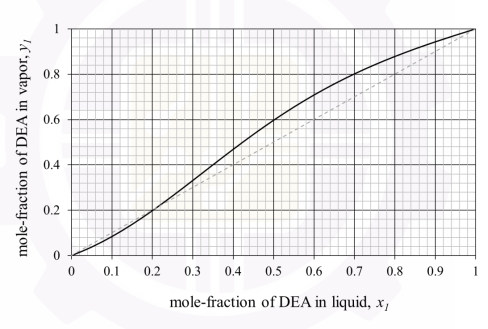
Group I Group II P. Component X 1. Butane Q. Component Y 2. Butadiene R. Component Z 3. Furfural A continuous distillation column is used to separate an equimolar mixture of diethylamine (DEA) and methanol. The feed enters the column as saturated liquid at a flow rate of $30 \text{ mol s}^{-1}$. It is desired to obtain $92 \text{ mol}\%$ DEA as distillate. The rate of withdrawal of the distillate from the column is $10 \text{ mol s}^{-1}$. The equilibrium curve for the conditions in the column is given below. The latent heat of vaporization of the reboiler contents is $35 \text{ kJ mol}^{-1}$. Neglect heat loss to the surroundings and assume constant molal overflow. Which one of the following is the minimum reboiler heat duty (in kW)?
- A binary AB liquid mixture containing 30 mol% A is subjected to differential (Rayleigh) distillation at atmospheric pressure in order to recover 60 mol% A in the distillate. Assuming a constant relative volatility $ \alpha_{AB} = 2.2 $, the average composition of the collected distillate is _______ mol% A (rounded off to nearest integer).
- Identify the WRONG statement amongst the following:
A binary feed consisting of $25$ mol% liquid and $75$ mol% vapour is separated in a staged distillation column. The mole fraction of the more volatile component in the distillate product is $0.95$. The molar flow rate of distillate is $50$% of the feed flow rate and the McCabe-Thiele method can be used to analyze the column. The q-line intersects the operating line of the enriching section at $(0.35, 0.5)$ on the x-y diagram. The slope of the stripping section operating line (up to one decimal place) is ____________


