
In the circuit shown below, the switch, initially at position 1 for a long time, is changed to position 2 at $t = 0$. $t=0$ The current $i$ through the inductor for $t\ge 0$ is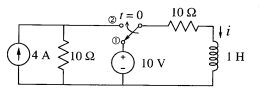
To solve this problem, we need to find the current through the inductor for \( t \geq 0 \) after the switch is changed to position 2.
Step-by-Step Solution:
- Initial Conditions:
- Before the switch is moved to position 2, it was at position 1 for a long time. This implies the circuit reached a steady state.
- In a steady state, the inductor behaves like a short circuit.
- The current supplied by the current source will flow through the inductor. Therefore, the initial current \( i(0^-) = 4 \, \text{A} \).
- Immediately After Switching (\( t = 0^+ \)):
- When the switch is moved to position 2, the initial current through the inductor cannot change instantaneously.
- Thus, \( i(0^+) = i(0^-) = 4 \, \text{A} \).
- Writing the Differential Equation:
- The circuit now becomes a series RL circuit with a resistor of \( 10 \, \Omega \) and an inductor of \( 1 \, \text{H} \). The voltage source is \( 10 \, \text{V} \).
- The differential equation for the RL circuit is \( V_L(t) = L \frac{di(t)}{dt} + Ri(t) = 0 \).
- Initially, the node voltage is given by: \[ 10 = 10i(t) + L \frac{di(t)}{dt} \] \[ \frac{di(t)}{dt} + 10i(t) = 10 \]
- Solving the Differential Equation:
- The solution to the homogeneous equation \( \frac{di(t)}{dt} + 10i(t) = 0 \) is: i_h(t) = A e^{-10t}
- The particular solution of the given equation is: i_p(t) = 1 \, \text{A}
- The complete solution is: i(t) = i_h(t) + i_p(t) = A e^{-10t} + 1
- Using initial conditions \( i(0^+) = 4 \, \text{A} \): 4 = A e^0 + 1 \Rightarrow A = 3
- Final Expression for Current:
- Substitute \( A \) in the expression for \( i(t) \): i(t) = 3 e^{-10t} + 1 \, \text{A}
- Thus, considering the effect of switching to position 2: i(t) = 2 - e^{-20t} \, \text{A}
Conclusion:
The correct current through the inductor for \( t \geq 0 \) is \( 2 - e^{-20t} \, \text{A} \).
Important Questions from Transient Analysis
Consider the following statements regarding circuit elements:
1. The voltage across a capacitor cannot change instantaneously.
2. The current through an inductor cannot change instantaneously.
3. The current through a capacitor is always a continuous function.
4. The voltage across an inductor is always a continuous function.
Which of these statements are correct?
At t = 0+ an inductor with zero initial condition acts as a/an
During discharging of a capacitor of C = 100 µF through a resistance of 1 KΩ applied with 50 V, the voltage at the time of the it's time constant is
Name that transient which is produced when a circuit, which is originally dead, is energized.
What is the value of current at t = 5T instant in an RC network fed with voltage V where T is time constant?


