
In the books of lessee the unrecouped amount of shortworkings is transferred to
Profit and Loss Account
Understanding Shortworkings in Lessee's Royalty Accounting
In royalty agreements, the lessee (the party paying the royalty) often has to pay a minimum amount to the lessor (the party receiving the royalty), regardless of the actual output or sales. This minimum amount is known as Minimum Rent or Dead Rent. If the royalty calculated based on output is less than the Minimum Rent for a period, the difference is called shortworkings. Shortworkings represent the excess of Minimum Rent over the actual royalty due.
Recoupment of Shortworkings
Lease agreements usually include a clause allowing the lessee to recoup shortworkings. This means if in a future period the actual royalty exceeds the Minimum Rent, the lessee can deduct the previously paid shortworkings amount from the excess royalty payable. The right to recoup shortworkings is typically available for a specific period (e.g., the first few years of the lease, or perpetually).
Treatment of Unrecouped Shortworkings in Lessee's Books
During the recoupment period, shortworkings that are expected to be recouped are treated as an asset or are kept in a separate shortworkings account. However, if the time limit for recouping the shortworkings expires and the lessee has not been able to recover the amount from excess royalties, this portion of unrecouped shortworkings becomes a loss for the lessee. In the lessee's books, this loss needs to be written off.
The universally accepted accounting treatment for unrecouped shortworkings in the lessee's books is to transfer them to the Profit and Loss Account. This is because the right to recover the amount has expired, and it is no longer an asset or recoverable expense. It is now considered an expense or loss incurred during the period when the recoupment right expired.
Let's consider the options given:
- Royalty Account: The Royalty Account deals with the actual royalty payable based on output or sales. Unrecouped shortworkings are not part of the current period's royalty calculation; they represent past deficits. So, it's not transferred here.
- Minimum Rent Account: The Minimum Rent Account records the minimum amount payable to the lessor. Shortworkings arise from the comparison of actual royalty with minimum rent, but the unrecouped amount isn't transferred back to this account.
- Lessor's Account: The Lessor's Account represents the amount due to the lessor. While shortworkings impact the payment to the lessor in early years, the unrecouped amount is a loss for the lessee, not an adjustment to the amount owed to the lessor after the payment has been made and the recoupment right has expired.
- Profit and Loss Account: This account is used to record all revenues and expenses/losses for a period. Since unrecouped shortworkings represent a loss to the lessee because the recovery right has lapsed, it is appropriately debited to the Profit and Loss Account in the period it becomes unrecoupable. This aligns with the principles of royalty accounting for losses.
Therefore, the unrecouped amount of shortworkings is transferred to the Profit and Loss Account in the lessee's books.
Important Questions from Miscellaneous
Read the given figure and find the region representing persons who are educated and employed but not confirmed in job.
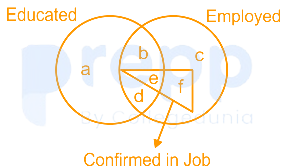
The magazine in which Mahatma Gandhi mentioned what he wanted the Constitution to do is:
Which gas shields the surface of the earth from ultraviolet radiation from the sun?
Which event is marked as an Intangible Cultural Heritage of Humanity by UNESCO?
Who has been conferred with the rank of the Commander of the Order of the British Empire in 2018?


