
In how many years will a sum of Rs. 1,25,000 become Rs. 1,57,464 at 16% per annum interest, if the interest is compounded half-yearly?
Compound Interest Calculation: Finding the Time Period
This problem asks us to determine the time it takes for a principal sum to grow to a specific amount under compound interest, compounded half-yearly. Understanding the formula for compound interest and how to apply it for half-yearly compounding is crucial here.
Understanding the Key Terms
- Principal Amount (P): This is the initial sum of money deposited or invested. In this question, the principal amount is Rs. 1,25,000.
- Amount (A): This is the total sum after the interest has been added to the principal. Here, the final amount is Rs. 1,57,464.
- Interest Rate (R): This is the rate at which interest is charged or earned annually. The given annual interest rate is 16% per annum.
- Compounding Frequency: This indicates how often the interest is calculated and added to the principal. In this problem, the interest is compounded half-yearly, meaning twice a year.
- Time (t): This is the duration for which the money is invested or borrowed, which we need to find in years.
Formula for Half-Yearly Compounding
When interest is compounded half-yearly, the annual interest rate is halved, and the number of compounding periods is doubled. The formula used is:
\[A = P \left(1 + \frac{R/2}{100}\right)^{2t}\]
Where:
- \(A\) = Final Amount
- \(P\) = Principal Amount
- \(R\) = Annual Interest Rate (in %)
- \(t\) = Time (in years)
- \(R/2\) = Half-yearly interest rate
- \(2t\) = Total number of half-years (compounding periods)
Step-by-Step Solution
Let's substitute the given values into the compound interest formula:
Given:
- Principal (P) = Rs. 1,25,000
- Amount (A) = Rs. 1,57,464
- Annual Rate (R) = 16%
Since the interest is compounded half-yearly:
- Half-yearly Rate = \(R/2 = 16\% / 2 = 8\%\)
Now, apply the formula:
\[157464 = 125000 \left(1 + \frac{8}{100}\right)^{2t}\]
Simplify the term inside the parenthesis:
\[157464 = 125000 \left(1 + 0.08\right)^{2t}\]
\[157464 = 125000 \left(1.08\right)^{2t}\]
To isolate the term with the exponent, divide both sides by the principal amount (1,25,000):
\[\frac{157464}{125000} = (1.08)^{2t}\]
Perform the division:
\[1.259712 = (1.08)^{2t}\]
Now, we need to find what power of 1.08 equals 1.259712. We can do this by testing powers of 1.08:
- \(1.08^1 = 1.08\)
- \(1.08^2 = 1.08 \times 1.08 = 1.1664\)
- \(1.08^3 = 1.1664 \times 1.08 = 1.259712\)
From the above calculation, we see that \( (1.08)^3 = 1.259712 \). Therefore, we can equate the exponents:
\[2t = 3\]
Finally, solve for \(t\):
\[t = \frac{3}{2}\]
\[t = 1.5 \text{ years}\]
Summary of Values
| Parameter | Value |
|---|---|
| Principal (P) | Rs. 1,25,000 |
| Amount (A) | Rs. 1,57,464 |
| Annual Rate (R) | 16% |
| Half-Yearly Rate | 8% |
| Time (t) | 1.5 years |
Thus, it will take 1.5 years for a sum of Rs. 1,25,000 to become Rs. 1,57,464 at 16% per annum interest, compounded half-yearly.
Important Questions from Miscellaneous
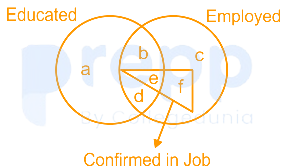
Read the given figure and find the region representing persons who are educated and employed but not confirmed in job.
The magazine in which Mahatma Gandhi mentioned what he wanted the Constitution to do is:
Which gas shields the surface of the earth from ultraviolet radiation from the sun?
Which event is marked as an Intangible Cultural Heritage of Humanity by UNESCO?
Who has been conferred with the rank of the Commander of the Order of the British Empire in 2018?


