In equilateral ΔABC, D and E are points on the sides AB and AC, respectively, such that AD = CE. BE and CD intersect at F. The measure (in degrees) of ∠CFB is:
120°
Given:
D and E are points located on the sides AB and AC respectively.
AD = CE
BE and CD intersect at F.
Concept Used:
Concept of triangle congruence,
The exterior angle is always equal to the sum of the opposite interior angles.
Calculation:
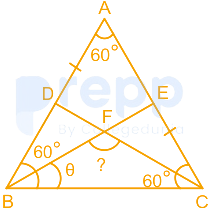
ΔCBE ≅ ΔACD [SAS Congruence]
Thus, all three angles of these two triangles are equal,
Let ∠EBC be θ, then ∠ACD is also θ.
Now,
∠BEC = 180° - (60° + θ)
⇒ 120° - θ
Now, in ΔECF
The exterior angle ∠CFB = (120° - θ) + θ
⇒ 120°
∴ ∠CFB is 120° .
Important Questions from Properties of Triangles
Consider the following statements:
1. If ABC is a right-angled triangle, right-angled at A, and if sin \(\rm B = \frac 1 3,\) then cosec C = 3.
2. If b cos B = c cos C and if the triangle ABC is not right-angled, then ABC must be isosceles.
Which of the above statements is/are correct?
- In a triangle \(ABC\), if \(a\), \(b\) and \(c\) are the lengths of the sides opposite to the angles \(A\), \(B\) and \(C\) respectively, then what is \(\frac{\sin(A-B)}{\sin(A+B)}\) equal to ?
In Δ ABC, ∠B = 90º, AC = 29 cm and BC = 20 cm. Then \(\frac{{1 - \sin A + \cos A}}{{1 + \sin A + \cos A}}\) is equal to:
The sides of a triangle are m, n and \(\rm \sqrt{m^2+n^2+mn}\) . What is the sum of the acute angles of the triangle?
Each side of a square subtends an angle of 60° at the tip of a tower of height h meters standing at the centre of the square. If l is the length of each side of the square, then what is h 2equal to?