
In case of Instalment Payment System, which one of the following statements is not true?
Understanding the Instalment Payment System
The question asks us to identify the statement that is not true regarding the Instalment Payment System. Let's analyze the characteristics of an Instalment Payment System to determine which statement is incorrect.
In an Instalment Payment System, the ownership of the goods passes immediately from the seller to the purchaser as soon as the agreement is signed and the goods are delivered. The purchaser becomes the legal owner right away. The payment of the total price, which includes the cash price and interest, is spread over a period in fixed instalments.
This is different from a Hire Purchase System, where ownership transfers only after the last instalment is paid. In Hire Purchase, the seller retains ownership until the final payment, giving them the right to repossess the goods upon default.
Analyzing the Statements about Instalment Payment System
Let's examine each statement provided in the options:
- Statement 1: Payment of purchase price is made in agreed instalments.
This statement is true. The fundamental concept of an Instalment Payment System is that the total price is paid in periodic, agreed-upon amounts called instalments.
- Statement 2: On default of payment of instalment, seller has a right to take back the goods.
This statement is generally not true for an Instalment Payment System. Because ownership transfers to the purchaser immediately upon delivery, the seller does not retain the right to simply take back the goods upon default. The seller's remedy in case of default is usually to sue the purchaser for the outstanding amount, along with any accrued interest and possibly damages. The right to repossess the goods is a characteristic feature of a Hire Purchase agreement, not a standard Instalment Payment System.
- Statement 3: Purchaser prepares Assets Account, Seller's Account and Interest Suspense Account in his books.
This statement is true regarding the accounting treatment under the Instalment Payment System. The purchaser records the asset at its cash price, acknowledges the total amount due to the seller (including interest), and often uses an Interest Suspense Account to manage the unaccrued interest, recognizing interest expense as instalments are paid.
- Statement 4: Purchaser has right to sell the asset at any time after receiving the delivery.
This statement is true. Since ownership passes to the purchaser immediately upon delivery in an Instalment Payment System, the purchaser has all the rights of an owner, including the right to use, pledge, or sell the asset without needing permission from the seller (though the debt obligation to the seller remains). This contrasts with Hire Purchase, where the hirer cannot sell the asset until full payment is made, as they are not yet the owner.
Identifying the Incorrect Statement on Instalment Payment System
Based on our analysis, the statement that is not true for an Instalment Payment System is that the seller has a right to take back the goods on default of payment of instalment. This right is specific to Hire Purchase agreements where ownership is retained by the seller until the end.
Important Questions from Miscellaneous
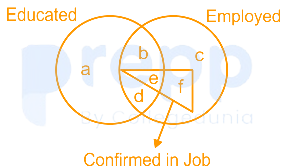
Read the given figure and find the region representing persons who are educated and employed but not confirmed in job.
The magazine in which Mahatma Gandhi mentioned what he wanted the Constitution to do is:
Which gas shields the surface of the earth from ultraviolet radiation from the sun?
Which event is marked as an Intangible Cultural Heritage of Humanity by UNESCO?
Who has been conferred with the rank of the Commander of the Order of the British Empire in 2018?


