
In an iron ore handling port, a barge is pulled by ropes using two tugboats as shown in the figure. In equilibrium, the resultant of the forces $T_1$ and $T_2$ along the axis of the barge in the direction of its travel is 5000 N. The tensions $T_1$ and $T_2$ in N respectively are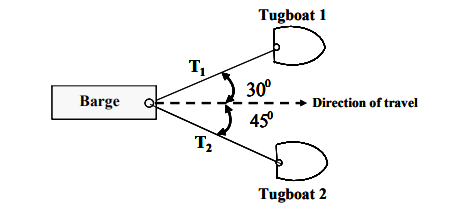
To solve this problem, we need to consider the forces acting on the barge due to the tensions \(T_1\) and \(T_2\). The resultant force along the direction of travel of the barge is given as 5000 N.
Here’s the approach to solve the problem step-by-step:
- Let \(\theta_1 = 30^\circ\) be the angle \(T_1\) makes with the direction of travel, and \(\theta_2 = 45^\circ\) be the angle \(T_2\) makes with the direction of travel.
- The horizontal components of \(T_1\) and \(T_2\) can be expressed using trigonometry:
- \(T_{1x} = T_1 \cdot \cos(30^\circ)\)
- \(T_{2x} = T_2 \cdot \cos(45^\circ)\)
- According to the problem, the sum of these horizontal components results in a force of 5000 N:
- \(T_1 \cdot \cos(30^\circ) + T_2 \cdot \cos(45^\circ) = 5000\)
- Using the cosine values, the equation becomes:
- \(T_1 \cdot \frac{\sqrt{3}}{2} + T_2 \cdot \frac{\sqrt{2}}{2} = 5000\)
- Along the vertical direction, the barge is in equilibrium since there is no vertical movement, thus:
- \(T_1 \cdot \sin(30^\circ) = T_2 \cdot \sin(45^\circ)\)
- Using the sine values, we have:
- \(T_1 \cdot \frac{1}{2} = T_2 \cdot \frac{\sqrt{2}}{2}\)
- Solving these equations simultaneously:
- From \(T_1 \cdot \frac{\sqrt{3}}{2} + T_2 \cdot \frac{\sqrt{2}}{2} = 5000\), and
- \(T_1 \cdot \frac{1}{2} = T_2 \cdot \frac{\sqrt{2}}{2}\), leading to \(T_1 = T_2 \sqrt{2}\).
- Substituting \(T_1 = T_2 \sqrt{2}\) in the first equation:
- \((T_2 \sqrt{2}) \cdot \frac{\sqrt{3}}{2} + T_2 \cdot \frac{\sqrt{2}}{2} = 5000\)
- After simplifying, we get \(T_2 = 2588\) N and \(T_1 = 3660\) N.
Thus, the tensions are 3660 N and 2588 N respectively.
The correct answer is: 3660 and 2588.
Important Questions from Vector Algebra
Vector A̅ = ŷ.3 + ẑ.2 and B̅ = x̂.5 + ŷ.8 extend from the origin. Find A̅.B̅ Choose the correct answer.
The value of the cross product \(\left( {\overrightarrow a - \overrightarrow b } \right) \times \left( {\overrightarrow a + \overrightarrow b } \right)\) of two vectors \(\overrightarrow a - \overrightarrow b\) and \(\overrightarrow a + \overrightarrow b \) is:
If non - zero a, b, c are such that a + b + c = 0, then the value of \(\frac{a^2}{bc} + \frac{b^2}{ac} + \frac{c^2}{ab}\) is
Vector a = 3i + 2j – 6k, vector b = 4i – 3j + k, angle between above vectors is
Two forces F1 and F2 are used to pull a car, which met an accident. The angle between the two force is θ. Find the value of θ for the resultant force is equal to \(\sqrt{(F_1^2 + F_2^2)}\)


