
In a progressive classroom, the curriculum is:
organised according to the capabilities and interests of the children
A progressive classroom follows the child-centred philosophy of John Dewey and the progressive education movement, echoed in NCF 2005 and NEP 2020. Here the learner, not the textbook, is the centre of the teaching-learning process.
In such a classroom the curriculum is flexible and is planned around the abilities, needs, experiences and interests of the children, so that learning connects with their lives and they enjoy a degree of autonomy in what and how they learn.
A rigid, highly structured curriculum that gives the child no autonomy describes a traditional, teacher-centred classroom. Fragmented subjects with no correlation and disconnected chunks of information go against the integrated, connected learning that progressive education promotes, since NCF 2005 asks for linking knowledge across subjects and to life outside school.
organised according to the capabilities and interests of the children option is correct.
Similar Questions
The value of the expression \((-3)^3 \times (0.3)^{-2} \times 0.01\) lies between which of the following ranges?
In a class test, a student earns 3 marks for every correct answer and loses 2 marks for every incorrect answer. No marks are given for questions left unattempted. If Radhika scored 20 marks and had 12 correct answers, how many questions did she attempt incorrectly?
If a polyhedron has 6 faces and 12 edges, what is the number of its vertices?
If \(a\) and \(b\) are positive integers (where \(b \neq 0\)) such that \(a^b = 1331\), then what is the value of \((a+b)^{a-b-8}\)?
Numbers that can be expressed as the sum of two cubes in two different ways are known as:
If \(x + \dfrac{y}{2} = \dfrac{1}{4}\), \(y + \dfrac{z}{2} = \dfrac{1}{4}\) and \(z + \dfrac{x}{2} = \dfrac{1}{4}\), then what is the value of \(x + y + z\)?
ABCD is a rhombus in which \(\angle BAC = 50^\circ\). What is the value of \(3\angle D - 2\angle DAC\)?
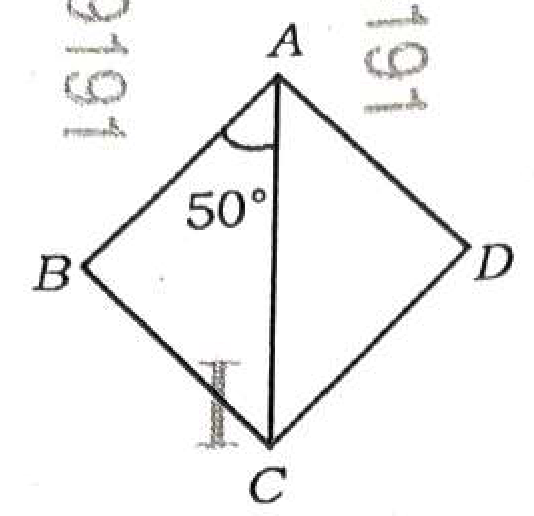
What is the value of \(\dfrac{\sqrt{450}}{\sqrt{338}} \div \dfrac{\sqrt{125}}{\sqrt{245}}\)?
The selling price of a toy is Rs. 1,020. If the profit made by the shopkeeper is 20%, what is the cost price of the toy?
The denominator of a rational number is greater than its numerator by 4. If 1 is added to both the numerator and the denominator, the resulting fraction is \(\dfrac{1}{2}\). Find the rational number.
Important Questions from Mixed Topic (JTET)
What type of process is thinking ?
The normal cause of origin of motivation is
How is impulse important for a teacher ?
The motive which forms due to social ideals, status, relations etc. is called
The learning in children starts from



