
In a certain population, 22% of people are smokers, 57% of people are males and 12% males are smokers. If a person is chosen at random from the population, what is that probality that selected person is either a male or a smoker?
0.67
Understanding Probability of Events
The question asks for the probability that a randomly selected person from a population is either a male or a smoker. This involves calculating the probability of the union of two events: being a male and being a smoker. We are given the individual probabilities of these events and the probability of a male being a smoker, which we will interpret as the probability of a person being both male and a smoker.
Given Probabilities
We are provided with the following information:
- Probability of a person being a smoker: P(Smoker) = 22% = 0.22
- Probability of a person being male: P(Male) = 57% = 0.57
- Probability that 12% males are smokers: We interpret this as the probability of a person being both male AND a smoker: P(Male and Smoker) = 12% = 0.12
Calculating Probability of Male or Smoker
To find the probability that the selected person is either a male or a smoker, we use the formula for the probability of the union of two events A and B:
\(\text{P(A or B)} = \text{P(A)} + \text{P(B)} - \text{P(A and B)}\)
In this case, Event A is selecting a male, and Event B is selecting a smoker. So, we want to find P(Male or Smoker).
Using the formula and the given probabilities:
\(\text{P(Male or Smoker)} = \text{P(Male)} + \text{P(Smoker)} - \text{P(Male and Smoker)}\)
\(\text{P(Male or Smoker)} = 0.57 + 0.22 - 0.12\)
\(\text{P(Male or Smoker)} = 0.79 - 0.12\)
\(\text{P(Male or Smoker)} = 0.67\)
Thus, the probability that the selected person is either a male or a smoker is 0.67.
Summary of Calculation Steps
- Identify the events: Event A = Male, Event B = Smoker.
- Note the given probabilities: P(Male) = 0.57, P(Smoker) = 0.22, P(Male and Smoker) = 0.12.
- Apply the formula for the union of two events: P(Male or Smoker) = P(Male) + P(Smoker) - P(Male and Smoker).
- Substitute the values: P(Male or Smoker) = 0.57 + 0.22 - 0.12.
- Calculate the result: P(Male or Smoker) = 0.67.
| Event | Probability |
|---|---|
| Smoker (S) | 0.22 |
| Male (M) | 0.57 |
| Male and Smoker (M and S) | 0.12 |
| Male or Smoker (M or S) | P(M) + P(S) - P(M and S) = 0.57 + 0.22 - 0.12 = 0.67 |
Revision Table: Key Probability Formulas
| Concept | Formula | Explanation |
|---|---|---|
| Probability of A or B (Union) | \(P(A \cup B) = P(A) + P(B) - P(A \cap B)\) | Used when finding the probability that at least one of two events occurs. Subtracts the intersection to avoid double-counting. |
| Probability of A and B (Intersection - Independent Events) | \(P(A \cap B) = P(A) \times P(B)\) | Used if events A and B are independent. |
| Probability of A and B (Intersection - Dependent Events) | \(P(A \cap B) = P(A|B) \times P(B) = P(B|A) \times P(A)\) | Used if events A and B are dependent. P(A|B) is the probability of A given B. |
| Conditional Probability | \(P(A|B) = \frac{P(A \cap B)}{P(B)}\) | The probability of event A occurring given that event B has already occurred. |
Additional Information: Probability Concepts
Probability is a measure of the likelihood that an event will occur. It is a value between 0 and 1, inclusive.
- Event: A specific outcome or a set of outcomes.
- Sample Space: The set of all possible outcomes of a random experiment.
- Union of Events (\(A \cup B\)): The event that occurs if A occurs, or B occurs, or both occur. Represented as "A or B".
- Intersection of Events (\(A \cap B\)): The event that occurs if both A and B occur. Represented as "A and B".
- Mutually Exclusive Events: Two events that cannot occur at the same time. If A and B are mutually exclusive, \(P(A \cap B) = 0\), and \(P(A \cup B) = P(A) + P(B)\).
- Independent Events: Two events where the occurrence of one does not affect the probability of the other. If A and B are independent, \(P(A \cap B) = P(A) \times P(B)\) and \(P(A|B) = P(A)\).
In this problem, being male and being a smoker are not mutually exclusive (as some males are smokers) and not independent (as the probability of being a smoker might be different for males and females, indicated by the provided P(Male and Smoker)). Therefore, the general formula for the union must be used.
Important Questions from Miscellaneous
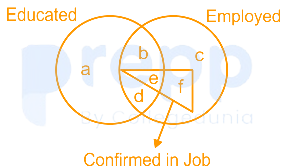
Read the given figure and find the region representing persons who are educated and employed but not confirmed in job.
The magazine in which Mahatma Gandhi mentioned what he wanted the Constitution to do is:
Which gas shields the surface of the earth from ultraviolet radiation from the sun?
Which event is marked as an Intangible Cultural Heritage of Humanity by UNESCO?
Who has been conferred with the rank of the Commander of the Order of the British Empire in 2018?


