
In a certain code language, P # Q means P is the wife of Q, P - Q means P is the mother of Q, P + Q means P is the father of Q, P & Q means P is the son of Q. Based on the above, how is E related to L in C # D + E # G + L?
Mother
Let's prepare the family tree diagram using the following symbols:
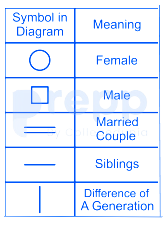
According to the given information:
P is the | ||||
Symbol | # | - | + | & |
Meaning | Wife | Mother | Father | Son |
of Q | ||||
Given expression: 'C # D + E # G + L'
C is the wife of D, D is the father of E, E is the wife of G, and G is the father of L.
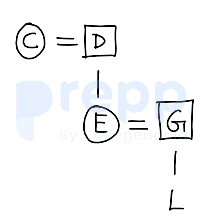
Here, E is the mother of L.
Hence, the correct answer is "Option (1)".
Important Questions from Coded Blood Relation Problems
If A @ B means A is the son of B, A # B means A is the husband of B and A * B means A is the daughter of B, then what does P @ Q * R # S mean?
If P $ Q means P is the husband of Q; P ! Q means P is the mother Q and P * Q means P is the daughter of Q, which of the following shows that Z is brother of W's wife, if Z is male?
If P $ Q means P is the brother of Q; P ! Q means P is the mother Q and P * Q means P is the son of Q, which of the following shows that W is brother of Z?
Read the following information carefully and answer the question given below:
M * N means ‘ M is the sister of N’
M % N means ‘ M is the father of N’
M # N means ‘M is the mother of N’
Which of the following option gives that, M is father of R?
If ‘A + B’ means ‘A is the mother of B’, ‘A - B’ means ‘A is the father of B’, ‘A × B’ means ‘A is the brother of B’, ‘A & B’ means ‘A is the son of B’, then how is M related to K in the expression ‘N − M + T × L & G & K’?


