
Directions: Consider the following Venn diagram, where X, Y and Z are three sets. Let the number of elements in Z be denoted by n(Z). which is equal to 90.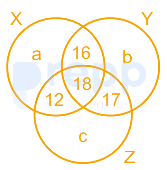
If the number of elements belonging to neither X, nor Y, nor Z is equal to p, then what is the number of elements in the complement of X?
p + b + 60
Concept:
Complement of X = U - X, where U is a universal set.
Calculation:
We know, n(X) + n(Y) + n(Z) - n(X ∩ Y) - n(Y ∩ Z) - n(X ∩ Z) + n(X ∩ Y ∩ Z) = n(X ∪ Y ∪ Z)
Here U - n(X ∪ Y ∪ Z) = p, whre U is a universal set
⇒ U - (a + b + 106) = p
⇒ U = p + (a + b + 106)
Now the number of elements in the complement of X, U - n(X) = p + (a + b + 106) - (a + 16 + 18 + 12)
= p + b + 60
Hence, option (1) is correct.
Similar Questions
Suppose set A consists of first 250 natural numbers that are multiple of 3 and set B consists of first 200 even natural numbers. How many elements does A ∪ B have?
If A = {x ∈ R : x 2+ 6x – 7 < 0} and B = {x ∈ R : x 2+ 9x + 14 > 0}, then which of the following is/are correct?
1. A ∩ B = {x ∈ R : - 2 < x < 1}2. A ∪ B = {x ∈ R : - 7 < x < - 2}
Select the correct answer using the code given below:If the number of elements in Y and Z are in the ratio 4 : 5, then what is the value of b?
What is the value of n(X) + n(Y) + n(Z) - n(X ∩ Y) - n(Y ∩ Z) - n(X ∩ Z) + n(X ∩ Y ∩ Z)?
A, B, C and D are four sets such that A ∩ B = C ∩ D = ϕ. Consider the following:
1. A ∪ C and B ∪ D are always disjoint.
2. A ∩ C and B ∩ D are always disjoint.
Which of the above statements is/are correct?Consider the following statements in respect of sets:
1. The union over the intersection of sets is distributive.
2. The complement of the union of two sets is equal to the intersection of their complements.
3. If the difference between the two sets is equal to the empty set, then the two sets must be equal.
Which of the above statements are correct?
A coin is tossed three times. Consider the following events:
A: No head appears
B: Exactly one head appears
C. At least two heads appear
Which one of the following is correct?
Consider the following :
1. A ∩ B = A ∩ C ⇒ B = C
2. A ∪ B = A ∪ C ⇒ B = C
Which of the above is/are correct ?
Consider all the subsets of the set A = {1, 2, 3, 4}. How many of them are supersets of the set {4}?
What can the minimum number of students in the school?
Important Questions from Operations on Sets
Match List I with List II
Let R 1= {(1, 1), (2, 2), (3, 3)} and R 2 = {(1, 1), (1, 2), (1, 3), (1, 4)}
List I
List II
(A) R 1∪ R 2
(I) {(1, 1), (1, 2), (1, 3), (1, 4), (2, 2), (3, 3)}
(B) R 1- R 2
(II) {1, 1}
(C) R 1∩ R 2
(III) {(1, 2), (1, 3), (1, 4)}
(D) R 2- R 1
(IV) {(2, 2), (3, 3)}
Choose the correct answer from the options given below:
Let R be a relation on a set A such that R = R-1, then R is
In a beauty contest, half the number of experts voted for Mr. A and two third voted for Mr. B. 10 voted for both and 6 did not for either. How many experts were there in all?
In a survey where 100 students reported which subjects they like, 32 students in total liked Mathematics, 38 students liked Business and 30 students liked Literature. Moreover 7 students liked both Mathematics and Literature, 10 students liked both Mathematics and Business, 8 students liked both Business and Literature, 5 students liked all three subjects.
Then the number of people who liked exactly one subject is
A professor has 24 text books on computer science and is concerned about their coverage of the topics (P) compilers, (Q) data structures and (R) Operating systems. The following data gives the number of books that contain material on these topics: n(P) = 8, n(Q) = 13, n(R) = 13, n(P ∩ R) = 3, n(P ∩ R) = 3, n(Q ∩ R) = 3, n(Q ∩ R) = 6, n(P ∩ Q ∩ R) = 2, where n(x) is the cardinality of the set x. Then the number of text books that have no material on compilers is



