If f(x) is differentiable at x = a and f'(a) = 0, then find the value of \(\displaystyle\lim_{h\to 0}\frac{f(a+2h^2)-f(a-2h^2)}{h^2}\)
0
Write the given expression as a difference of two increments at \(a\): \(\dfrac{f(a+2h^2)-f(a-2h^2)}{h^2}=\dfrac{f(a+2h^2)-f(a)}{h^2}-\dfrac{f(a-2h^2)-f(a)}{h^2}\).
Since \(2h^2\to 0\) as \(h\to 0\), by the definition of the derivative \(\displaystyle\lim_{h\to0}\dfrac{f(a+2h^2)-f(a)}{2h^2}=f'(a)\), so \(\dfrac{f(a+2h^2)-f(a)}{h^2}=2\cdot\dfrac{f(a+2h^2)-f(a)}{2h^2}\to 2f'(a)\).
Similarly, \(\dfrac{f(a-2h^2)-f(a)}{h^2}=-2\cdot\dfrac{f(a-2h^2)-f(a)}{-2h^2}\to -2f'(a)\).
Subtracting, the limit becomes \(2f'(a)-(-2f'(a))=4f'(a)\).
Since \(f'(a)=0\), the value of the limit is \(4\times 0=0\).
Similar Questions
If \(f(x)=\begin{cases}ax+b & : x\le -1\\ ax^3+x+2b & : x>-1\end{cases}\) is differentiable for \(x\in \mathbb{R}\), find (a, b)
Important Questions from Differentiability
A differentiable function $f(x)$ is such that $f(-0.1) = 2, f(0) = 1, \text{ and } f(0.1) = 2$.
Then, $\frac{d^2f}{dx^2}$ at $x = 0$ is ______ (answer in integer).
- The differential of the equation, $x^2 + y^2 =1$, with respect to $x$ is
Suppose the function f(x) = x n, n ≠ 0 is differentiable for all x. Then n can be any element of the interval
The figure shows the distance vs time graph of a moving particle. The tangents to the curve at A and B make angles of $45^\circ$ and $60^\circ$ respectively with the time axis.
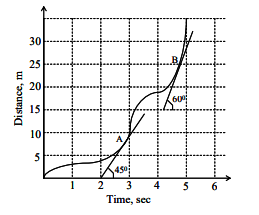
The ratio of the speeds of the particle at B and at A isDerivative of cos x with respect to x is