
If a discrete time sequence $x[n]$ is given by 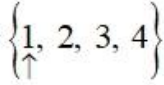 . Then $x((n-2)_4)$ will be given by
To solve the given problem, we need to determine the sequence \( x((n-2)_4) \) when the original discrete time sequence is given by the image displayed. Here's the step-by-step reasoning:
- Understanding the Sequence Transformation: The problem requires us to find \( x((n-2)_4) \). Here, \((n-2)_4\) denotes a modulo operation on the shifted index \( n-2 \).
- Original Sequence: The original sequence is given as \( \{1, 2, 3, 4\} \).
- Shifting and Modulo Operation: We apply the transformation to each element index of the sequence:
- When \( n = 0 \), \((n-2)_4 = (-2)_4 = 2 \), giving element \( x[2] = 3 \).
- When \( n = 1 \), \((n-2)_4 = (-1)_4 = 3 \), giving element \( x[3] = 4 \).
- When \( n = 2 \), \((n-2)_4 = 0 \), giving element \( x[0] = 1 \).
- When \( n = 3 \), \((n-2)_4 = 1 \), giving element \( x[1] = 2 \).
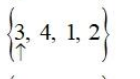
- Constructed Resultant Sequence: The sequence \( x((n-2)_4) \) becomes \(\{3, 4, 1, 2\}\).
- This transformation reflects a circular shift on the sequence, achieved by the combination of shifting and modulo operations.
Thus, the resultant sequence after the given transformation is:
Important Questions from Introduction To Signals and Systems
All energy signals will have an average Power of
Arrange the following system types in ascending order of their intersection with 0 dB axis.
A. Type N system
B. Type 3 system
C. Type 2 system
D. Type 4 system
Choose the correct answer from the options given below
Given below are two statements
Statement I: The scaling theorem relates scale changes in frequency domain to the consequent changes in scale in the time domain.
Statement II: The scaling theorem is not applicable to an impulse signal.
In light of the above statements, choose the correct answer from the options given below
The period of the signal X(t) = cos (2 πt) cos (4 πt) – sin (2πt) sin (4πt) is
The time period of a 50 kHz sine wave is


