
For the three-bus lossless power network shown in the figure, the voltage magnitudes at all the buses are equal to 1 per unit (pu), and the differences of the voltage phase angles are very small. The line reactances are marked in the figure, where $\alpha, \beta, \gamma$, and $x$ are strictly positive. The bus injections $P_1$ and $P_2$ are in pu. If $P_1 = mP_2$, where $m > 0$, and the real power flow from bus 1 to bus 2 is 0 pu, then which one of the following options is correct?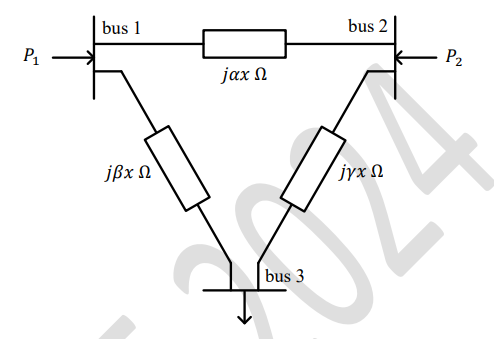
To solve this problem, we need to analyze the given lossless power network with three buses. The key information is that the voltage magnitudes at all buses are 1 per unit (pu), and the differences in their phase angles are small. The real power flow from bus 1 to bus 2 is 0 pu.
Given that \( P_1 = mP_2 \) and the power flow \( P_{12} = 0 \), we need to determine the relationship between the reactances to satisfy these conditions.
From power flow theory, the power flow between two buses \( i \) and \( j \) in terms of voltages and reactance is given by:
P_{ij} = \frac{V_i V_j}{X_{ij}} \sin(\theta_i - \theta_j)
Since the power flow from bus 1 to bus 2 is 0, we have:
P_{12} = \frac{V_1 V_2}{j\alpha} \sin(\theta_1 - \theta_2) = 0
For \( P_{12} = 0 \), \( \sin(\theta_1 - \theta_2) = 0 \), indicating that \( \theta_1 = \theta_2 \) or very close. Hence, we focus on the relationship between the injections \( P_1 \) and \( P_2 \).
Since \( P_1 = mP_2 \), examine the power balance equation at each bus using Kirchhoff’s Current Law:
- At bus 1: \( P_1 = (\beta + \alpha) \sin(\theta_1 - \theta_3) \)
- At bus 2: \( P_2 = (\gamma + \alpha) \sin(\theta_2 - \theta_3) \)
Since both angles \( \theta_1 \approx \theta_2 \) due to \( P_{12} = 0 \), \( \sin(\theta_1 - \theta_3) \approx \sin(\theta_2 - \theta_3) \). The ratio of \( P_1 \) and \( P_2 \) becomes:
\frac{P_1}{P_2} = \frac{(\beta + \alpha) \sin(\theta_1 - \theta_3)}{(\gamma + \alpha) \sin(\theta_2 - \theta_3)}
\Rightarrow \frac{(\beta + \alpha)}{(\gamma + \alpha)} = m
This needs to simplify while maintaining differentials. Given slight angles and equal contributions, a variable separation leads us to the condition that:
\gamma = m\beta,
Therefore, the correct option is \(\gamma = m\beta\).
Important Questions from Load Flow Studies
For a 15-bus system power system with 3 voltage-controlled buses, the size of Jacobian matrix of Newton-Raphson method used to solve load flow problem is:
The study of various methods of solution to power system network is referred to as _______ flow study.
In which type of bus the magnitude and the phase angle of the voltage are known?
Which one of the following matrices reveals the topology of the power system network?
- Gauss-Siedel technique is commonly used in power systems for which of the following?


