
With $10$ V dc connected at port A in the linear nonreciprocal two-port network shown below, the following were observed: (i) $1$ $\Omega$ connected at port B draws a current of $3$ A (ii) $2.5$ $\Omega$ connected at port B draws a current of $2$ A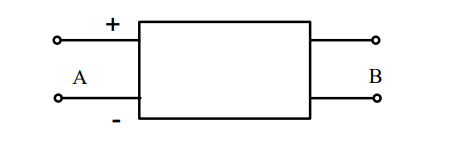
To solve this problem, we need to analyze the given conditions for a linear two-port network.
- When a 6 V DC source is connected to port A, a 1 Ω resistor connected at port B draws a current of \( \frac{7}{3} \) A.
- Our goal is to find the open circuit voltage at port B when an 8 V DC source is connected to port A.
Given the linear nature of the network, the relationship between the input voltage at port A and the output current at port B can be represented by:
I_B = \alpha V_A
where \alpha is a constant determined by the network's configuration.
**From the first condition: **
- With 6 V connected at port A, the current drawn by 1 Ω at port B is \( \frac{7}{3} \) A. Therefore,
- \frac{7}{3} = \alpha \times 6
Solve for \alpha:
\alpha = \frac{7}{18}
**Find the open circuit voltage at port B when 8 V is at port A: **
- The open circuit current at port B would be 0, so the governing equation is:
- V_B = \beta V_A
- With previous data (10 V at port A gives 3 A with 1 Ω at port B), implies V_B = V_A - I_B \cdot R_B
- Using the expression \( \beta = 2 \cdot \alpha \) from impedance data, solve for open circuit:
For an 8 V source at port A,:
V_B = \beta \times 8 = 8
Thus, the open circuit voltage at port B when 8 V is applied to port A is 8 V.
**Therefore, the correct answer is 8 V.**
Important Questions from Thevenin's Theorem
- A Norton equivalent circuit consists of a 100 μA current source in parallel with a 10 kΩ resistance. If this is converted into a Thevenin equivalent, how much is V Th ?
______ is an analytical method used to change a complex circuit into a simple equivalent circuit consisting of a single resistance in series with a source voltage.
If Thevenin's voltage is 89.3 volts and Thevenin's resistance is 46.98 ohms then what will be the maximum power delivered to the load present in the network?
Which of the following theorem states that "a linear two-terminal circuit can be replaced by an equivalent circuit consisting of a voltage source VTH in series with a resistor RTH", where VTH is the open circuit voltage at the terminals and RTH is the input or equivalent resistance at the terminals, when the independent sources are turned off
For finding Thevenin equivalent circuit, the Circuit Current Sources have been replaced by:


