
For the given process 1-2-3-4-1 on a P-V scale. 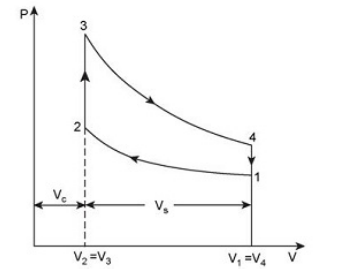
Which is the correct representation of the above process on a T-S scale?
The given process on a P-V scale appears to represent a cycle often found in thermodynamics, involving processes such as expansion and compression. To identify the correct representation on a T-S scale, let's analyze the cycle step-by-step:
- Process 1-2:
This process is an isobaric expansion, meaning the pressure remains constant while the volume increases. On a T-S diagram, this is typically represented as a horizontal line moving to the right, indicating an increase in entropy.
- Process 2-3:
This segment represents an isochoric (constant volume) process, where the temperature increases at constant volume. On a T-S diagram, it is shown as a vertical line moving upwards.
- Process 3-4:
During this isobaric compression, pressure remains constant while volume decreases. On a T-S scale, it is depicted as a horizontal line moving to the left, indicating a decrease in entropy.
- Process 4-1:
This process is an isochoric (constant volume) process with decreasing temperature. On a T-S diagram, this is shown as a vertical line moving downwards.
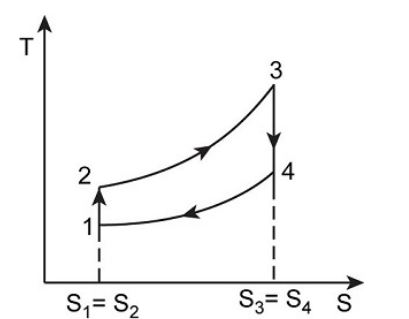
Through this analysis, the cycle on a T-S diagram should look like a rectangle oriented to the right, with horizontal (isobaric) and vertical (isochoric) lines aligning with the respective entropy changes. The option that best fits this description is:
Hence, the correct representation of the given process on a T-S scale is option (the image shown above).
Conclusion: The T-S diagram illustrates the thermodynamic process cycle, with areas under the curve representing heat transfer. This helps understand the efficiency and work done during the cycle.
Important Questions from Thermodynamics System and Processes
Select the right expression for Vander Waal’s equation for a real gas.
Which of the following pairs of thermodynamic properties can uniquely fix the state of a substance like water, irrespective of its thermodynamic state?
A Monoatomic ideal gas (y = 1.67 Molecular weight = 40) is compressed adiabatically from 0.1 Mpa 300K to 0.2Mpa. The universal gas constant is 8.314KJ/kgK. The work of the compression of gas in KJ/kg is. (Take (2)y-1/y = 1.32)
A reversible polytropic process can be described by
A gas goes through a process given by pv2 = c. It expands from state 1 of 350 kPa and 0.049 m3 to a final pressure of 150 kPa. Work delivered during this process in kJ is:


